
Cross Sections of Circles
Loading the math board and drawing, please wait…
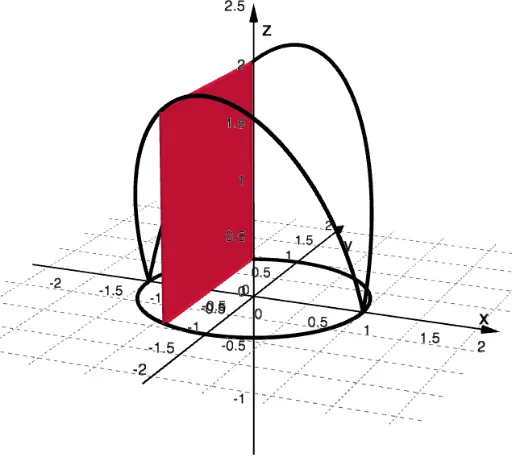
This example demonstrates the various cross-sectional shapes formed by slicing through a circular solid at different angles. It involves core mathematical concepts such as solid geometry, integral calculus, and geometric construction. Key GeoGebra commands and objects used in the construction include Sphere, Circle, Polygon, Segment, and Midpoint. Suitable for high school and above students to explore 3D shapes and their properties in calculus applications.
GeoGebra Commands & Parameters
IndexOf(SelectedElement[shape], shape) → aCurveCartesian(cos(t), sin(t), 0, t, 0, π) → bCurveCartesian(x(b(t)), y(b(t)), (2 * y(b(t))), t, 0, π) → eCurveCartesian(cos(t), (-sin(t)), 0, t, 0, π) → dCurveCartesian(x(b(t)), (-y(b(t))), (2 * y(b(t))), t, 0, π) → fPolygon(A, C, D, B) → q1, a_1, c_1, d_1, b_1Surface(x(b(t)), y(b(t)), (u * z(e(t))), t, 0, π, u, 0, 1) → gSurface(x(d(t)), y(d(t)), (u * z(f(t))), t, 0, π, u, 0, 1) → hCurveCartesian(cos(t), 0, (sqrt(3) * sin(t)), t, 0, π) → jSurface((u * x(b(t))) + ((1 - u) * x(d(t))), (u * y(b(t))) + ((1 - u) * y(d(t))), (u * z(e(t))) + ((1 - u) * z(f(t))), t, 0, π, u, 0, 1) → iPolygon(A, B, E) → t1, e_1, a_2, b_2Surface((u * x(b(t))) + ((1 - u) * x(j(t))), (u * y(b(t))) + ((1 - u) * y(j(t))), (u * z(b(t))) + ((1 - u) * z(j(t))), t, 0, π, u, 0, 1) → kSurface((u * x(d(t))) + ((1 - u) * x(j(t))), (u * y(d(t))) + ((1 - u) * y(j(t))), (u * z(d(t))) + ((1 - u) * z(j(t))), t, 0, π, u, 0, 1) → lSegment(A, B) → mMidpoint(m) → FCurveCartesian(x(F), (m / 2 * cos(t)), (m / 2 * sin(t)), t, 0, (2 * π)) → oSphere((0, 0, 0), 1) → qCircle(o(1), o(0), o(0.5)) → r
AI Drawing Prompt Reference
Draw various cross-sectional shapes formed by slicing a circular solid at different angles, showcasing geometric objects like spheres, circles, polygons, and segments. Start with a base circle, then generate cross-sectional curves through integral calculations, combine these curves to form polygons and surfaces, and finally integrate the surfaces with a sphere to present cross-sectional shapes at different angles, demonstrating the integration of solid geometry and calculus.
The prompt above was compiled from the original drawing commands and is for reference only.