
Circle Section of a 3-Sphere
Loading the math board and drawing, please wait…
In collections
Spherical sections of a 3-Sphere
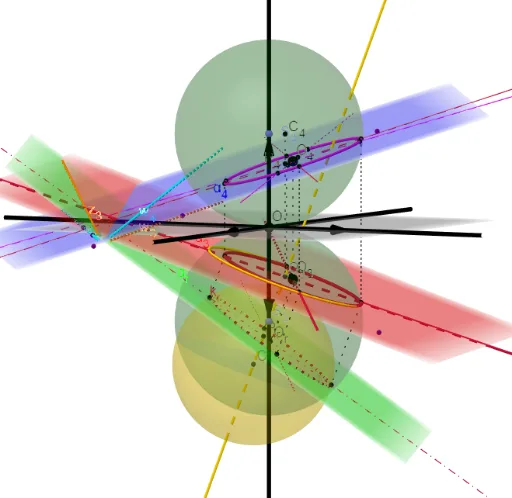
① This example demonstrates how to obtain a circular cross-section of a 4-dimensional unit sphere (3-Sphere) by intersecting it with a 3-dimensional hyperplane, and shows the projection of that circle into 3D space. ② Core mathematical concepts include higher-dimensional spheres, hyperplanes, orthogonal projection, generation of circles and ellipses, and interactions among points, lines, and planes in four dimensions. ③ Construction highlights: using GeoGebra commands such as Point, Intersect, Sphere, Line, Vector, Plane, OrthogonalLine, IntersectPath, Center, Radius, Distance, Segment, OrthogonalPlane, Midpoint, Circle, and Ellipse, along with numerous auxiliary objects (e.g., S_4, Σ_4, S_3, Σ_3, D, f, E, g, h, p) and direction vectors (xdir, ydir, wdir, zdir) to precisely control the section position, finally generating the circle c and its radius r. ④ Suitable for advanced undergraduate or graduate students studying higher-dimensional geometry, topology, or mathematical visualization, and also useful as an interactive teaching tool for instructors to illustrate abstract high-dimensional concepts.
GeoGebra Commands & Parameters
Point(zAxis) → S_4Intersect(zAxis, yAxis) → OSphere(S_4, 1) → Σ_4Point(zAxis) → S_3Sphere(S_3, 1) → Σ_3Point(xAxis) → DLine(O, D) → fPoint(yAxis) → ELine(O, E) → gLine(O, S_4) → hVector(O, D) → xdirVector(O, E) → ydirVector(O, S_4) → wdirVector(O, S_3) → zdirPointIn(p) → APointIn(p) → BLine(A, B) → z_4Line(G, H) → w_3Plane(C, z_4) → α_4Plane(F, w_3) → α_3OrthogonalLine(B, xOyPlane) → iOrthogonalLine(A, xOyPlane) → jIntersect(j, α_3) → IIntersect(i, α_3) → JLine(I, J) → z_3OrthogonalLine(G, xOyPlane) → w_1OrthogonalLine(H, xOyPlane) → lIntersect(l, α_4) → KIntersect(w_1, α_4) → LLine(L, K) → w_4IntersectPath(α_3, Σ_3) → cCenter(c) → C_3Radius(c) → rOrthogonalLine(C_3, α_3) → kDistance(O, S_4) → wSSphere(C_3, wS) → b_1Intersect(k, b_1) → C_r, NSphere(C_r, r) → dOrthogonalLine(C_3, xOyPlane) → mIntersect(m, α_4) → P_4Plane(S_4, xOyPlane) → q_2Intersect(m, q_2) → C_4Segment(C_4, C_3) → l_2Intersect(m, xOyPlane) → C_0Distance(P_4, C_0) → wCSphere(C_3, wC) → a_1Intersect(k, a_1) → P_r, PPlane(P_r, z_3) → α_rIntersectPath(α_r, d) → k_rOrthogonalPlane(C_3, z_3) → qIntersect(q, k_r) → M, QMidpoint(M, Q) → O_rOrthogonalLine(O_r, q) → tLine(M, Q) → sIntersect(t, k_r) → R, SLine(O_r, k) → nIntersect(n, α_3) → O_3Line(M, k) → g_1Line(Q, k) → i_1Intersect(i_1, α_3) → TIntersect(g_1, α_3) → WDistance(T, C_3) → b_2Line(R, k) → a_2Line(S, k) → eIntersect(a_2, α_3) → UIntersect(e, α_3) → VLine(U, V) → f_1Line(W, T) → h_1Distance(V, O_3) → aDistance(O_3, T) → bCircle(T, a, i_1) → c_1Intersect(f_1, c_1) → Z, A_1Segment(M, W) → m_2Segment(R, U) → n_2Segment(O_r, A_1) → r_2Segment(S, V) → s_2Segment(Q, T) → t_2Segment(O_r, O_3) → f_3Ellipse(Z, A_1, W) → d_1OrthogonalLine(W, xOyPlane) → j_1OrthogonalLine(T, xOyPlane) → k_1OrthogonalLine(V, xOyPlane) → l_1OrthogonalLine(U, xOyPlane) → m_1Intersect(j_1, α_4) → B_1Intersect(l_1, α_4) → C_1Intersect(m_1, α_4) → D_1Intersect(k_1, α_4) → E_1OrthogonalLine(O_3, xOyPlane) → n_1Intersect(n_1, α_4) → O_4Segment(T, E_1) → g_3Segment(V, C_1) → h_3Segment(U, D_1) → i_3Segment(W, B_1) → j_3Segment(O_3, O_4) → k_3Line(E_1, B_1) → p_1Line(C_1, D_1) → q_1OrthogonalPlane(O_4, q_1) → r_1IntersectPath(r_1, α_4) → s_1OrthogonalLine(O_4, α_4) → t_1Circle(t_1, C_1) → e_1Intersect(s_1, e_1) → F_1, G_1Line(G_1, E_1) → f_2Midpoint(E_1, G_1) → H_1OrthogonalLine(H_1, α_4) → g_2Circle(g_2, O_4) → c_2Intersect(f_2, c_2) → I_1, J_1Line(J_1, O_4) → h_2Line(I_1, O_4) → i_2Distance(J_1, E_1) → a_4Distance(G_1, J_1) → b_4Circle(O_4, a_4, t_1) → d_2Circle(O_4, b_4, t_1) → e_2Intersect(i_2, d_2) → K_1, L_1Intersect(h_2, e_2) → M_1, N_1OrthogonalLine(N_1, α_4) → j_2Circle(N_1, a_4, j_2) → k_2Intersect(i_2, k_2) → O_1, P_1Ellipse(P_1, O_1, N_1) → p_2