
Multiplying Multi-Digit and 1-Digit Numbers Using Partial Products
Loading the math board and drawing, please wait…
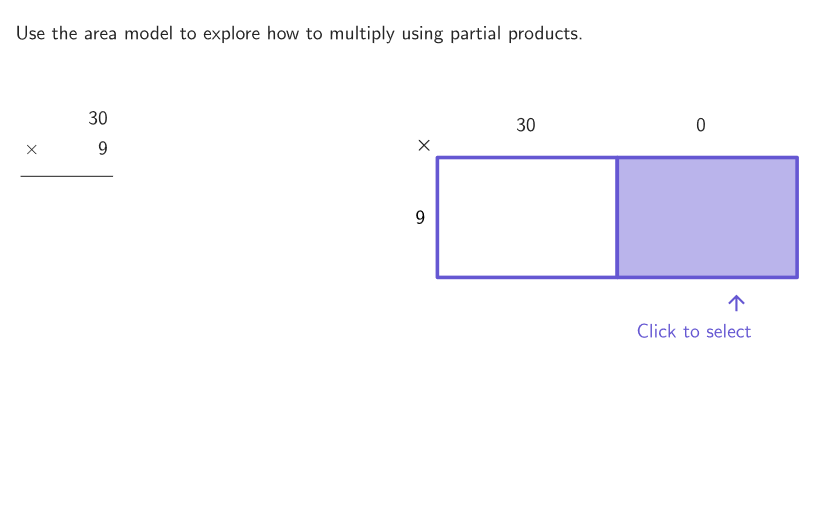
This example demonstrates how to multiply multi-digit whole numbers by 1-digit whole numbers using partial products and area models. It involves breaking down the multi-digit number into parts, calculating the product of each part step by step, and then adding the results to get the final answer. Key math concepts include the distributive property of multiplication, partial product method, and area models. GeoGebra commands and objects used in the construction include Shuffle, Element, TextToUnicode, SelectedIndex, If, Intersect, Point, Polygon, Sequence, Zip, and Translate. Suitable for upper elementary students learning multiplication of multi-digit numbers, helping them understand the principles and steps of multiplication.
GeoGebra Commands & Parameters
Shuffle(Sequence[t, t, 1, 3]) → allCases, {2, 3, 1}Element(allCases, Mod[countQuestion, Length[allCases]] + 1) → caseNumShuffle(Sequence[t, t, 1, 9]) → allD4, {8, 1, 9, 7, 5, 6, 3, 4, 2}Element(allD4, Mod[countQuestion, Length[allD4]] + 1) → d4Shuffle(Sequence[t, t, 1, 9]) → allD2, {9, 5, 3, 7, 6, 2, 4, 8, 1}Element(allD2, Mod[countQuestion, Length[allD2]] + 1) → d2Shuffle(Sequence[t, t, 1, 9]) → allD3, {8, 9, 1, 5, 6, 2, 3, 4, 7}Element(allD3, Mod[countQuestion, Length[allD3]] + 1) → d3Shuffle(Sequence[t, t, 2, 9]) → allMult, {7, 8, 9, 6, 2, 5, 3, 4}Element(allMult, Mod[countQuestion, Length[allMult]] + 1) → multShuffle(Sequence[t, t, 0, 9]) → allD1, {6, 2, 0, 8, 5, 4, 9, 7, 1, 3}Element(allD1, Mod[countQuestion, Length[allD1]] + 1) → d1TextToUnicode(("" * currentProd)) → uniResultSelectedIndex(ddMenu) → isIf(caseNum ≟ 1, 217 + 74, caseNum ≟ 2, 255 + 73, 292 + 65) → obj5PosYIntersect(xAxis, yAxis) → APoint(xAxis) → BIf(caseNum ≠ 3, A + (0, -1.5), If[caseNum ≟ 3 ∧ currentProd ≥ 10000, A + (-1, -1.5), A + (0, -1.5)]) → recapTextPosPolygon({A, D, DH, AH}) → rett31Polygon({D, C, CH, DH}) → rett32Polygon({C, E, EH, CH}) → rett33Polygon({E, B, BH, EH}) → rett34Polygon({A, C, CH, AH}) → rett11Polygon({C, B, BH, CH}) → rett12Polygon({A, F, FH, AH}) → rett21Polygon({F, G, GH, FH}) → rett22Polygon({G, B, BH, GH}) → rett23Sequence((k, 7), k, If[caseNum ≟ 1, 3, caseNum ≟ 2, 2, 1], x(B) - x(A), If[caseNum ≟ 1, (0.5 * (x(B) - x(A))), caseNum ≟ 2, (1 / 3 * (x(B) - x(A))), (1 / 4 * (x(B) - x(A)))]) → anchorsUpZip(Text[("" * A), B, false, true, 1, 0], A, If[caseNum ≟ 1, allValues1Up, caseNum ≟ 2, allValues2Up, allValues3Up], B, anchorsUp + (-0.15, -0.5)) → allTextsUpSequence((k, 3), k, If[caseNum ≟ 1, 3, caseNum ≟ 2, 2, 1], x(B) - x(A), If[caseNum ≟ 1, (0.5 * (x(B) - x(A))), caseNum ≟ 2, (1 / 3 * (x(B) - x(A))), (1 / 4 * (x(B) - x(A)))]) → anchorsInSequence((-14, k), k, If[caseNum ≟ 1, 0, caseNum ≟ 2, -3, -5], 4, If[caseNum ≟ 1, 2, caseNum ≟ 2, 2, 3]) → rightAnchorsVert1Polygon({A, C, CH, AH}) → rett11FramePolygon({C, B, BH, CH}) → rett12FramePolygon({A, F, FH, AH}) → rett21FramePolygon({F, G, GH, FH}) → rett22FramePolygon({G, B, BH, GH}) → rett23FramePolygon({A, D, DH, AH}) → rett31FramePolygon({D, C, CH, DH}) → rett32FramePolygon({C, E, EH, CH}) → rett33FramePolygon({E, B, BH, EH}) → rett34FramePolygon(C, B, BH, CH) → pulsingObject1, f, g, i, jPolygon(G, B, BH, GH) → pulsingObject2, k, l, m, nPolygon(E, B, BH, EH) → pulsingObject3, p, q, r, sIf(caseNum ≟ 1, 260, caseNum ≟ 2, 302, caseNum ≟ 3, 345) → separatBottYPolygon({R1, R2, R3, R4}) → hlRett11Translate(R1, Vector[(0, 0), (0, -1)]) → R1'Translate(R2, Vector[(0, 0), (0, -1)]) → R2'Translate(R3, Vector[(0, 0), (0, -1)]) → R3'Translate(R4, Vector[(0, 0), (0, -1)]) → R4'Polygon({R1 + (0, -1.85), R2 + (0, -1.85), R3 + (0, -1.85), R4 + (0, -1.85)}) → hlRett12Translate(hlRett11, Vector[(0, 0), (0, -3.65)]) → hlRett23Translate(hlRett23, Vector[(0, 0), (0, -1.65)]) → hlRett32
AI Drawing Prompt Reference
Draw a multiplication decomposition diagram to show the process of multiplying a multi-digit number by a single-digit number. Start by drawing a rectangle to represent the product of the multiplication. Then, divide the rectangle into smaller rectangles, each representing an intermediate result of the multiplication. For example, if the multi-digit number is 217 and the single-digit number is 74, the rectangle will be divided into two parts, representing the results of 200 multiplied by 74 and 17 multiplied by 74. Finally, label each smaller rectangle with its dimensions and product.
The prompt above was compiled from the original drawing commands and is for reference only.