
Missing Complementary Angle
Loading the math board and drawing, please wait…
In collections
Angles!
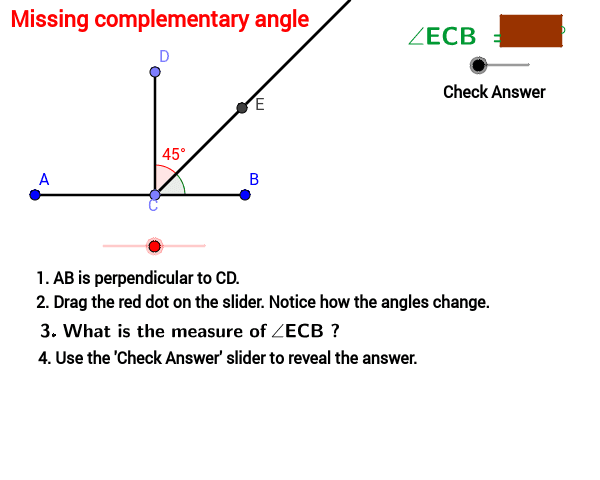
This GeoGebra example demonstrates how to find the missing complementary angle in a geometric figure, where complementary angles sum to 90 degrees. The core mathematical concepts include the definition of complementary angles, angle calculation, geometric construction techniques, and properties of polygons that may be involved. In terms of construction, the example uses various GeoGebra commands such as Line, Point, OrthogonalLine, Segment, Rotate, Angle, Ray, Polygon, Vector, and Translate, to create points like A, B, C, angles α, β, γ, and transformed points like F', G', etc., thereby building a complete figure to illustrate angle relationships. This example is suitable for middle school or high school students to practice and understand the concept of complementary angles, enhancing their geometric construction skills.
GeoGebra Commands & Parameters
Line(A, B) → aPoint(a) → COrthogonalLine(C, a) → bSegment(A, B) → dPoint(b) → DSegment(C, D) → eRotate(D, -α, C) → EAngle(E, C, D) → βRay(C, E) → cAngle(B, C, E) → γPolygon(F, G, H, I) → P, f, g, h, iVector((8, 6), (8 + j, 6)) → uTranslate(F, u) → F'Translate(G, u) → G'Translate(H, u) → H'Translate(I, u) → I'Polygon(F', G', H', I') → P', f', g', h', i'
AI Drawing Prompt Reference
Draw a right triangle ABC with AB and BC as the legs, then take a point C on BC and draw a perpendicular line from C to the extension of AB to get point D. Construct angle α, then rotate point D to get point E and calculate angle β. Next, draw a quadrilateral FGHI, and then translate this quadrilateral 8 units using vector u to get a new quadrilateral F'G'H'I'.
The prompt above was compiled from the original drawing commands and is for reference only.