
Meteorologist's Weather Balloon Angle Example
Loading the math board and drawing, please wait…
In collections
PARCC Math II Unit 5 Lesson 5
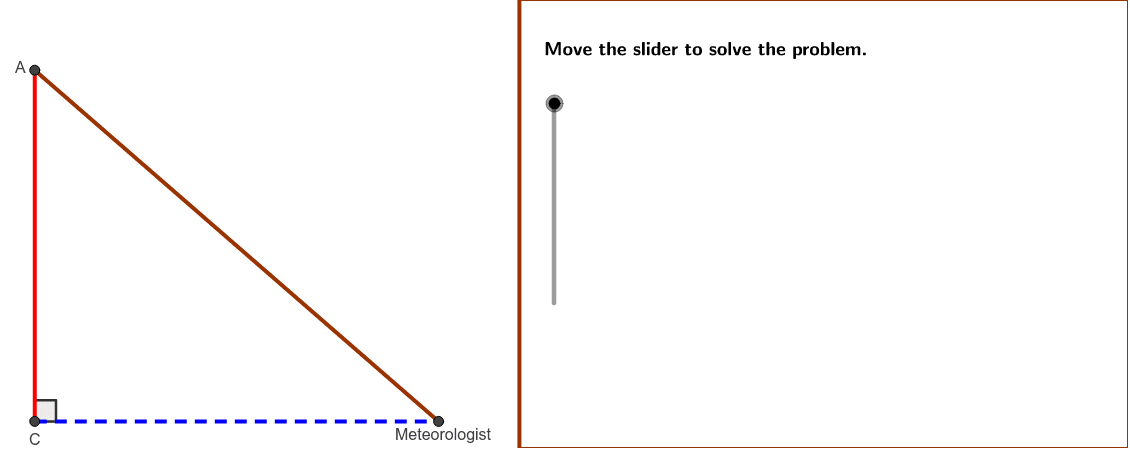
This example demonstrates how a meteorologist uses radio signals to gather information from a weather balloon by measuring angles, focusing on calculating the balloon's height using trigonometric principles. Key math concepts include trigonometry, solid geometry, vectors, and ratios. The construction involves GeoGebra commands like Min, Polygon, Segment, Angle, and objects such as angleB, distanceAB, distanceBC, C, distanceAC, lengthAC, Edge, Mask, a, b, c, d, steps2, AppHeader, steps, lengthBC, B, BC, A, AC, AB, ABC, BCA, CAB, W, AdjacentLength, LengthAC, Directions4, IndentifyInfo, Theta, labelx, A2, BalloonHeight, pic1, AngDecline, Directions1, SliderDirections, Directions2, ChooseFunction, Directions3. Suitable for high school students learning applications of solid geometry and trigonometry.
GeoGebra Commands & Parameters
Min(5, (5 * distanceAC / distanceBC)) → lengthACPolygon((Edge, y(Corner[1])), Corner[2], Corner[3], (Edge, y(Corner[4]))) → Mask, a, b, c, dMin(5, (5 * distanceBC / distanceAC)) → lengthBCSegment(C, B) → BCSegment(A, C) → ACSegment(A, B) → ABAngle(A, B, C) → ABCAngle(B, C, A) → BCAAngle(C, A, B) → CABSegment(A, A2) → BalloonHeightAngle(A2, A, B) → AngDecline
AI Drawing Prompt Reference
Draw an example showing how a meteorologist uses radio signals to measure a weather balloon's height by angles, focusing on trigonometric calculations. Include a triangle formed by three points, a vertical line from the balloon to the ground, labeled angles and side lengths, with different colors for clarity, demonstrating trigonometry and solid geometry concepts.
The prompt above was compiled from the original drawing commands and is for reference only.