
Mesh Surface Modeling of a Rhombicosidodecahedron and Its Dual
Loading the math board and drawing, please wait…
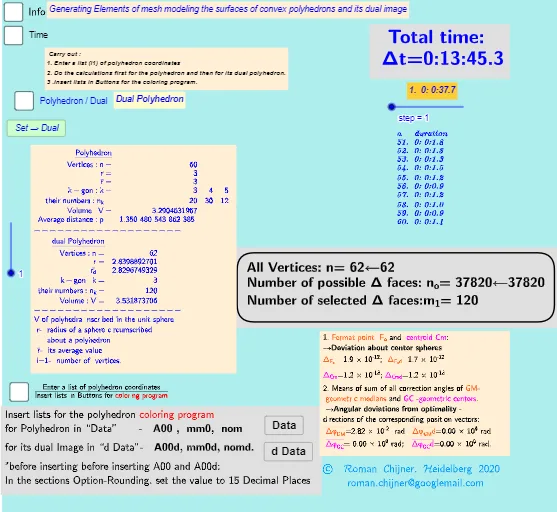
This example demonstrates how to generate a mesh-based representation of the surfaces of a Rhombicosidodecahedron (with V=60) and to model its dual solid, the Deltoidal Hexecontahedron (V=62). It highlights the geometric relationship between primal and dual polyhedra while approximating and visualizing their surface structure through discrete mesh elements. Key mathematical ideas include solid geometry, duality of polyhedra, vector/geometry-driven measurements, and quantitative metrics such as volume/spherical-enclosed values (e.g., Vol and related computed quantities). Construction-wise, the GeoGebra workflow uses command patterns such as Sequence to create parameter/index lists, If to conditionally select elements, Element and Sum to assemble contributing mesh parts, IndexOf/First to locate specific items, and Max to control extrema-driven choices. Length is used for geometric size computations, while Text and TableText present computed values like Volsphere, Vol, and dual-related volume terms. Suitable for high school advanced geometry through early university courses, and for math visualization activities focused on parametrized construction and 3D mesh modeling.
GeoGebra Commands & Parameters
Text("" + p) → txt_pSum(Flatten[Sequence[Append[Sequence[Element[txt_p, i], i, m01(k), m02(k)], " "], k, 1, 5]]) → txtUm1If(bu0, A00, A00d) → A00_0Length(A00_0) → nLength(l2) → läl2Sequence(sgn(Determinant[{Element[A00_0, i1] - Element[A00_0, j], Element[A00_0, i2] - Element[A00_0, j], Element[A00_0, i3] - Element[A00_0, j]}]), j, 1, n) → l01Length(A00d) → zzzSum(Zip[(T * F), T, SysTimeAkt1, F, {1, 1000, 60000, 3600000, 86400000}]) → TimeAbs1Sum(Zip[(T * F), T, SysTimeAkt2, F, {1, 1000, 60000, 3600000, 86400000}]) → TimeAbs2Div(TimeRelab, 3600) → HDiv(TimeRelab - (H * 3600), 60) → MElement(ZwZeit, step) → text10TableText({Append["a duration", Last[ZwZeit, Min[10, Length[ZwZeit]]]]}, "v") → text2cLength(A00) → lm1If(Length[Unique[l01 \ {0}]] ≟ 1, 7, -7) → a7Sum(Zip[(T * F), T, SysTimeAkt0, F, {1, 1000, 60000, 3600000, 86400000}]) → TimeAbs0Div(TimeRelab0, 3600) → H0Div(TimeRelab0 - (H0 * 3600), 60) → M0Text("" + (TimeRelab0 - (H0 * 3600) - (M0 * 60))) → S0aText("" + (TimeRelab - (H * 3600) - (M * 60))) → SIndexOf(".", S) → indexIndexOf(".", S0a) → indexaFirst(S, index + 1) → txtSFirst(S0a, indexa + 1) → txtS0aIf(bu0, " ", "d") → txtbuoMax(Length[A00], Length[A00d]) → maxläElement(A00, 24) → m11TableText({{"\underline{Polyhedron}"}, Append["Vertices: n=", {Length[A00]}], Append["r=", {r}], Append["\bar{r}=", {r_m}], Append["k-gon : k=", mm5a], Append["their\; numbers: n_k=", mm7a], Append["Volume: V=", {Vol_r}], Append["Average\; distance: p=", {txtUm1}]}, "hr ") → text7TableText({{"\underline{dual\;Polyhedron}"}, Append["Vertices: n=", {Length[A00d]}], Append["r=", {r_d}], Append[" \bar{r_d}= ", {r_md}], Append["k-gon : k=", mm5ad], Append["their\; numbers: n_k=", mm7ad], Append["Volume: V=", {Vold_r}]}, "hr ") → text20
AI Drawing Prompt Reference
Create a 3D visualization of a polyhedron and its dual using a surface mesh approximation. First construct a rhombicosidodecahedron-like solid with about 60 vertices, then discretize its surface into mesh elements to model the visible facets. Next construct its dual polyhedron (a deltoidal hexecontahedron-like solid) with about 62 vertices, again representing its surface through a mesh. Use the measured geometric size parameters to scale both solids consistently and emphasize the correspondence between the primal and dual surfaces. Add on-screen text/table labels reporting key computed quantities such as vertex counts, radius-type values, volume, and an average-distance value.
The prompt above was compiled from the original drawing commands and is for reference only.