
Medians and Equal Areas!
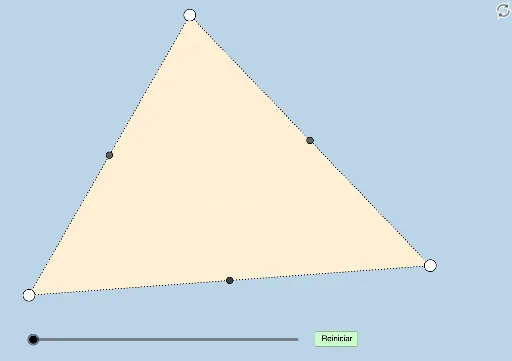
Loading the math board and drawing, please wait…
This example demonstrates how medians of a triangle divide it into equal areas. Key concepts include the centroid of a triangle, vectors, and geometric construction. Using GeoGebra commands such as Segment, Midpoint, Intersect, etc., the properties of medians are visually illustrated. Suitable for middle school and above students to learn geometry and vector concepts.
GeoGebra Commands & Parameters
Segment(A, B) → aSegment(C, A) → bSegment(C, B) → cMidpoint(a) → DMidpoint(c) → EMidpoint(b) → FSegment(C, D) → dSegment(A, E) → eSegment(B, F) → fIntersect(f, e) → HOrthogonalLine(D, e) → gOrthogonalLine(F, e) → hOrthogonalLine(E, d) → iOrthogonalLine(F, d) → jIntersect(g, e) → GIntersect(h, e) → IIntersect(j, d) → KOrthogonalLine(E, f) → kOrthogonalLine(D, f) → lPolygon(A, B, C) → poly1, c_1, a_1, b_1Dilate(A, If[1 < m ≤ 2, 2 - m, 0], E) → A'Dilate(C, If[0 < m ≤ 1, 1 - m, 0], D) → C'Dilate(B, If[2 < m ≤ 3, 3 - m, 0], F) → B'Segment(A, A') → nSegment(B, B') → pSegment(C, C') → qOrthogonalLine(H, a) → rOrthogonalLine(H, b) → sOrthogonalLine(H, c) → tIntersect(r, a) → LIntersect(s, b) → MIntersect(t, c) → NDilate(B, If[4 < m ≤ 5, 5 - m, 0], D) → B'_1Dilate(H, If[4 < m ≤ 5, 5 - m, 0], L) → H'Segment(H, H') → e_1Angle(H, L, A) → αAngle(H, M, C) → βAngle(H, N, B) → γSegment(B, D) → d_1Segment(H, H') → h_1Polygon(D, B, H) → poly2, h_2, d_2, b_2Dilate(B, If[6 < m ≤ 7, 7 - m, 0], D) → B'_3Vector(B, B'_3) → vTranslate(D, v) → D'Segment(B'_3, D') → i_1Polygon(D', H, B'_3) → poly3, b'_3, d', h_3Midpoint(I, G) → PDilate(D, If[8 < m ≤ 9, 9 - m, 0], G) → D'_1Segment(D, D'_1) → j_1Angle(D, G, H) → δAngle(F, I, A) → εDilate(F, If[8 < m ≤ 9, 9 - m, 0], I) → F'Segment(F, F') → k_1Polygon(D, B, H) → poly4, h_4, d_3, b_3Polygon(H, D, A) → poly5, a_2, h_5, d_4Polygon(A, H, F) → poly6, f_2, a_3, h_6Polygon(F, H, C) → poly7, c_2, f_3, h_7Polygon(H, E, C) → poly8, c_3, h_8, e_2Polygon(H, E, B) → poly9, b_4, h_9, e_3Segment(A, H) → f_1Rotate(D, If[9.5 < m ≤ 10.5, ((m - 9.5) * π), 3.141592653589793], P) → D'_2Rotate(D'_1, If[9.5 < m ≤ 10.5, ((m - 9.5) * π), 3.141592653589793], P) → OSegment(D'_2, O) → g_1Polygon(A, H, F) → poly10, f_4, a_4, h_{10}Dilate(H, If[11 < m ≤ 12, 12 - m, 0], M) → H'_1Segment(A, F) → l_1Segment(H, H'_1) → m_1Dilate(F, If[12.5 < m ≤ 13.5, 13.5 - m, 0], C) → F'_1Vector(F, F'_1) → uTranslate(A, u) → A'_1Translate(F, u) → F'_2Segment(A'_1, F'_2) → n_1Polygon(A'_1, H, F'_1) → poly11, f'_1, a'_1, h_{11}Dilate(F, If[14.5 < m ≤ 15.5, 15.5 - m, 0], K) → F'_3Segment(F, F'_3) → p_1Segment(C, H) → q_1Angle(F, K, H) → ζPolygon(H, E, C) → poly12, c_4, h_{12}, e_4Line(C, D) → r_1OrthogonalLine(E, r_1) → s_1Intersect(s_1, r_1) → JAngle(E, J, C) → ηDilate(E, If[14.5 < m ≤ 15.5, 15.5 - m, 0], J) → E'Segment(E, E') → t_1Midpoint(K, J) → RRotate(F, If[16 < m ≤ 17, ((m - 16) * π), 3.141592653589793], R) → F'_4Rotate(F'_3, If[16 < m ≤ 17, ((m - 16) * π), 3.141592653589793], R) → SSegment(F'_4, S) → g_2Dilate(H, If[17.5 < m ≤ 18.5, 18.5 - m, 0], N) → H'_2Segment(H, H'_2) → j_2Segment(C, E) → i_2Dilate(C, If[19 < m ≤ 20, 20 - m, 0], E) → C'_1Vector(C, C'_1) → wTranslate(E, w) → E'_1Translate(C, w) → C'_2Translate(E, w) → E'_2Segment(C'_2, E'_2) → k_2Polygon(C'_1, H, E'_1) → poly13, e'_1, c'_1, h_{13}Line(F, B) → l_2OrthogonalLine(E, l_2) → m_2OrthogonalLine(D, l_2) → n_2Intersect(l_2, n_2) → TIntersect(m_2, l_2) → USegment(H, B) → p_2Dilate(E, If[20.5 < m ≤ 21.5, 21.5 - m, 0], U) → E'_3Dilate(D, If[20.5 < m ≤ 21.5, 21.5 - m, 0], T) → D'_3Segment(E, E'_3) → q_2Segment(D, D'_3) → r_2Angle(E, U, F) → θAngle(D, T, B) → ιSegment(H, B) → s_2Midpoint(U, T) → VRotate(E, If[22 < m ≤ 23, ((m - 22) * π), 3.141592653589793], V) → E'_4Rotate(E'_3, If[22 < m ≤ 23, ((m - 22) * π), 3.141592653589793], V) → WSegment(E'_4, W) → t_2Polygon(B, D, H) → poly14, h_{14}, b_5, d_5Polygon(A, D, H) → poly15, h_{15}, a_5, d_6Polygon(A, H, F) → poly16, f_5, a_6, h_{16}Polygon(F, H, C) → poly17, c_5, f_6, h_{17}Polygon(H, E, C) → poly18, c_6, h_{18}, e_5