
Medians and Centroid Dance by Tim Brzezinski
Loading the math board and drawing, please wait…
In collections
Congruence (CO) Cluster
Congruence (Vol 2)
CCSS High School: Geometry (Congruence) Volume 2
CCSS High School: Geometry (Congruence) Volume 2
CCSS High School: Geometry (Congruence) Volume 2
Geometry (Congruence) Volume 2
CCSS High School: Geometry (Congruence) Volume 2
CCSS High School: Geometry (Congruence) Volume 2
CCSS High School: Geometry (Congruence) Volume 2
CCSS High School: Geometry (Congruence) Volume 2
CCSS High School: Geometry (Congruence) Volume 2
CCSS High School: Geometry (Congruence) Volume 2
Gail LeBlancCCSS High School: Geometry (Congruence) Volume 2
CCSS High School: Geometry (Congruence) Volume 2
CCSS High School: Geometry (Congruence) Volume 2
Triangle Theorems
Triangles: Points of Concurrency
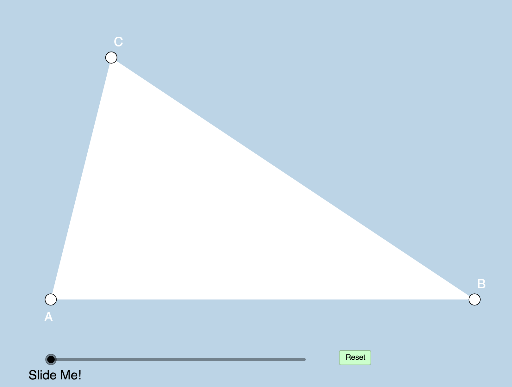
This example dynamically demonstrates the relationship between medians and the centroid of a triangle, visually proving the centroid theorem. It involves core concepts like medians, centroids, and geometric transformations, constructed using GeoGebra commands such as Midpoint, Segment, Intersect, Dilate, Rotate, and Polygon. Ideal for high school mathematics education or exploration by geometry enthusiasts.
GeoGebra Commands & Parameters
Midpoint(A, B) → DMidpoint(B, C) → EMidpoint(C, A) → FSegment(A, B) → aSegment(B, C) → bSegment(C, A) → cSegment(C, D) → dSegment(A, E) → eSegment(B, F) → fIntersect(d, e) → GDilate(A, If[0 < g ≤ 1, 1 - g, 0], D) → A'Segment(A, A') → hRotate(A, If[1 < g ≤ 2, ((-(g - 1)) * π), (-π)], D) → A'_1Rotate(A', If[1 < g ≤ 2, ((g - 1) * π), 3.141592653589793], D) → A''Segment(A'_1, A'') → h'Dilate(B, If[2 < g ≤ 3, 3 - g, 0], E) → B'Segment(B, B') → iRotate(B, If[3 < g ≤ 4, ((-(g - 3)) * π), (-π)], E) → B'_1Rotate(B', If[3 < g ≤ 4, ((g - 3) * π), 3.141592653589793], E) → B''Segment(B'_1, B'') → i'Dilate(C, If[4 < g ≤ 5, 5 - g, 0], F) → C'Segment(C, C') → jRotate(C, If[5 < g ≤ 6, ((-(g - 5)) * π), (-π)], F) → C'_1Rotate(C', If[5 < g ≤ 6, ((g - 5) * π), 3.141592653589793], F) → C''Segment(C'_1, C'') → j'Midpoint(G, C) → HMidpoint(G, B) → IMidpoint(A, G) → JDilate(C, If[6 < g ≤ 7, 7 - g, 0], H) → C'_2Segment(C, C'_2) → kDilate(H, If[7 < g ≤ 8, 8 - g, 0], G) → H'Segment(H, H') → lDilate(G, If[8 < g ≤ 9, 9 - g, 0], D) → G'Segment(G, G') → mDilate(A, If[9 < g ≤ 10, 10 - g, 0], J) → A'_2Segment(A, A'_2) → nDilate(J, If[10 < g ≤ 11, 11 - g, 0], G) → J'Segment(J, J') → pDilate(G, If[11 < g ≤ 12, 12 - g, 0], E) → G'_1Segment(G, G'_1) → qPolygon(A, B, C) → poly1, c_1, a_1, b_1Dilate(F, If[12 < g ≤ 13, 13 - g, 0], G) → F'Segment(F, F') → rRotate(F, If[14 < g ≤ 15, ((g - 14) * π), 3.141592653589793], G) → F'_1Rotate(F', If[14 < g ≤ 15, ((g - 14) * π), 3.141592653589793], G) → F''Segment(F'_1, F'') → r'Rotate(F'_1, If[15 < g ≤ 16, ((g - 15) * π), 3.141592653589793], I) → KRotate(F'', If[15 < g ≤ 16, ((g - 15) * π), 3.141592653589793], I) → F'''Segment(K, F''') → r''Rotate(G, If[16 < g ≤ 17, ((g - 16) * π), 3.141592653589793], G) → G'_2Rotate(G'_1, If[16 < g ≤ 17, ((g - 16) * π), 3.141592653589793], G) → LSegment(G'_2, L) → q'Rotate(G'_2, If[17 < g ≤ 18, ((g - 17) * π), 3.141592653589793], J) → MRotate(L, If[17 < g ≤ 18, ((g - 17) * π), 3.141592653589793], J) → L'Segment(M, L') → q''Rotate(G, If[18 < g ≤ 19, ((g - 18) * π), 3.141592653589793], G) → G'_3Rotate(G', If[18 < g ≤ 19, ((g - 18) * π), 3.141592653589793], G) → G''Segment(G'_3, G'') → m'Rotate(G'_3, If[19 < g ≤ 20, ((g - 19) * π), 3.141592653589793], H) → NRotate(G'', If[19 < g ≤ 20, ((g - 19) * π), 3.141592653589793], H) → G'''Segment(N, G''') → m''
AI Drawing Prompt Reference
Draw a triangle and find the midpoint of each side. Connect each midpoint to the opposite vertex to form the medians. Mark the intersection point of the medians, which is the centroid. Demonstrate the properties of the centroid dynamically, showing the ratio of distances from the centroid to the vertices and to the midpoints of the sides, and further verify the centroid theorem using geometric transformations.
The prompt above was compiled from the original drawing commands and is for reference only.