
Median, Angle Bisector, and Altitude Concurrency in a Triangle
Loading the math board and drawing, please wait…
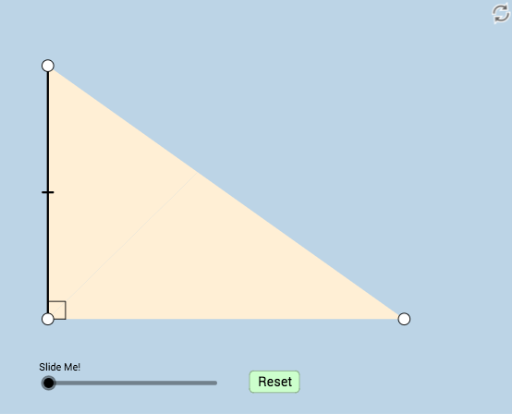
This example dynamically illustrates the concurrency of the median, angle bisector, and altitude in a triangle. Key mathematical concepts include medians, angle bisectors, and altitudes. The construction uses GeoGebra commands such as Segment, OrthogonalLine, Point, etc. Suitable for middle school and above students learning geometric construction.
GeoGebra Commands & Parameters
Segment(A, B) → fOrthogonalLine(A, f) → gPoint(g) → CRay(A, C) → hRay(A, C) → iPoint(i) → DSegment(A, D) → jSegment(D, B) → kAngle(B, A, D) → αCircle(B, j) → cIntersect(c, k, 1) → ESegment(B, E) → lSegment(D, E) → mOrthogonalLine(E, j) → nAngle(A, D, E) → βRotate(A, β / 2, D) → A'Angle(A, D, A') → γRay(D, A') → pIntersect(n, p) → FMidpoint(m) → GIntersect(n, j) → HSegment(A, E) → rSegment(G, F) → qSegment(F, A) → sIntersect(p, r) → IOrthogonalLine(B, f) → tPoint(t) → JAngle(J, B, E) → δPolygon(D, A, E) → poly1, e, d, aPolygon(A, B, E) → poly2, e_1, a_1, bSegment(D, H) → f_1Segment(D, G) → g_1Min(f_1, g_1) → oCircle(D, (0.6 * o)) → c_1Segment(D, E) → h_1Intersect(c_1, h_1, 1) → KIntersect(c_1, j, 1) → LIntersect(c_1, p, 1) → MCircleSector(D, L, M) → d_1Dilate(A, If[0 < u ≤ 1, 1 - u, 0], B) → A'_1Vector(A, A'_1) → vTranslate(A, v) → A'_2Translate(D, v) → D'Segment(A'_2, D') → j'Rotate(A'_2, If[1 < u ≤ 2, ((u - 1) * δ), δ], B) → NRotate(D', If[1 < u ≤ 2, ((u - 1) * δ), δ], B) → D''Segment(N, D'') → j''Dilate(E, If[2 < u ≤ 3, 3 - u, 0], G) → E'Segment(E, E') → i_1Rotate(E, If[3 < u ≤ 4, ((u - 3) * π), π], G) → E'_1Rotate(E', If[3 < u ≤ 4, ((u - 3) * π), π], G) → E''Segment(E'_1, E'') → j_1Dilate(A, If[4 < u ≤ 5, 5 - u, 0], E) → A'_3Segment(A, A'_3) → k_1Polygon(A, E, D) → poly3, d_2, a_2, e_2Segment(E, H) → l_1Angle(A, H, E) → εDilate(E, If[5 < u ≤ 6, 6 - u, 0], H) → E'_2Segment(E, E'_2) → m_1Dilate(D, If[6 < u ≤ 7, 7 - u, 0], F) → D'_1Segment(D, D'_1) → n_1Dilate(F, If[7 < u ≤ 8, 8 - u, 0], I) → F'Segment(F, F') → p_1Rotate(d_1, If[8 < u ≤ 9, ((u - 8) * γ), γ], D) → q_1Dilate(A, If[9 < u ≤ 10, 10 - u, 0], F) → A'_4Segment(A, A'_4) → r_1Dilate(F, If[10 < u ≤ 11, 11 - u, 0], G) → F'_1Segment(FF, F'_1) → s_1
AI Drawing Prompt Reference
Draw a triangle and construct its median, angle bisector, and altitude, highlighting their point of concurrency. Then, draw a circle centered at the intersection of the angle bisector, intersecting the altitude at two points. Connect these points to the triangle's vertices to form two smaller triangles. Finally, rotate and scale one of the smaller triangles to observe geometric transformations.
The prompt above was compiled from the original drawing commands and is for reference only.