
Maximum Volume of a Cylinder Inscribed in a Cone
Loading the math board and drawing, please wait…
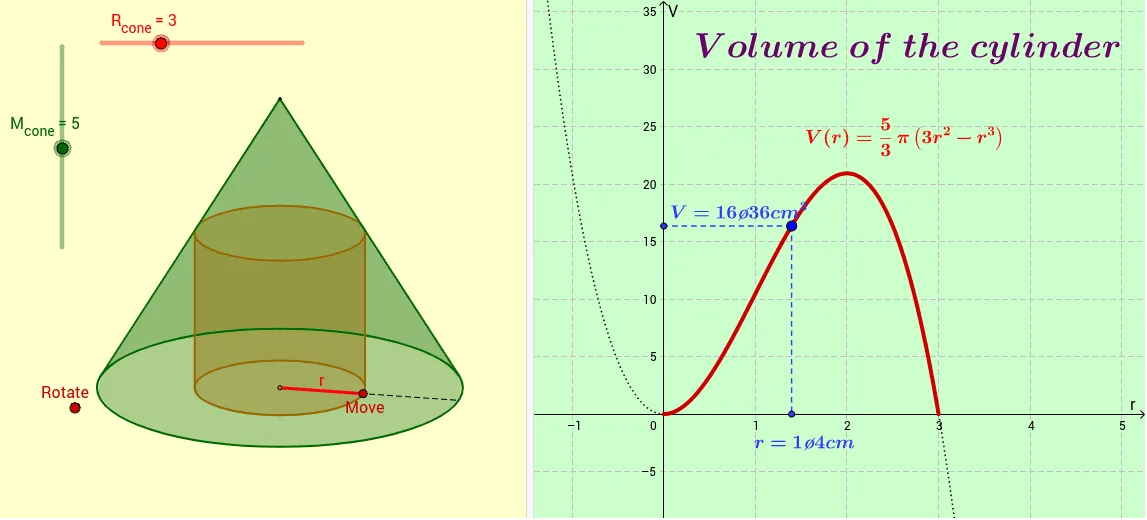
This GeoGebra example demonstrates how to find the largest possible volume of a cylinder that can be inscribed inside a given cone. It visualizes the geometric setup, the relationship between the cylinder's height and radius via similar triangles, and the resulting volume as a function of height. The core mathematical concepts include solid geometry (cone and cylinder), proportional reasoning, function modeling, and optimization using calculus (derivative or maximum value). The construction uses GeoGebra commands such as Vector, Kúp (cone), Segment, Point, Distance, Henger (cylinder), and Function. Objects like O, i, j, k, M_cone, R_cone, K, A, lista1, c, a1, a2, a, B, b, C, d, e, r, f, m, D, lista2, g, h, l, n, V, P, V1, P1, P2, p, q, szöveg1-4, and Max are used to build the dynamic model, plot the volume function, and highlight the maximum point. This is suitable for high school or early college students studying geometry, precalculus, or calculus, especially for understanding applied optimization problems.
GeoGebra Commands & Parameters
Vector((cos(x(O)), -1 * sin(x(O)) * sin(y(O)))) → iVector((-1 * sin(x(O)), -1 * cos(x(O)) * sin(y(O)))) → jVector((0, cos(y(O)))) → kKúp(O, K, R_{cone}, M_{cone}) → A, lista1, c, a1, a2Segment(K, B) → bPoint(b) → CDistance(K, B) → dDistance(K, C) → eSegment(K, C) → fHenger(O, K, r, m) → D, lista2, g, h, l, nFunction(V, 0, R_{cone}) → V1Segment(P, P1) → pSegment(P, P2) → q
AI Drawing Prompt Reference
Create a 3D geometry diagram showing a cone and an inscribed cylinder, emphasizing how the cylinder’s volume varies with its height. Start by fixing the cone’s apex and axis, drawing the cone surface and choosing a position for the cylinder’s axis inside the cone. Mark the key connecting segments from the cone apex to the cylinder’s reference points on the boundary, including the necessary distances that correspond to similar triangles. Then construct the inscribed cylinder within the cone, indicating its radius and height as adjustable quantities, along with the relevant contact/defining points and segments. Finally, set up a volume-vs-height relationship and include the curve representation and a highlighted maximum point where applicable.
The prompt above was compiled from the original drawing commands and is for reference only.