
Loyd’s Squares Construction on a 3-4-5 Right Triangle
Loading the math board and drawing, please wait…
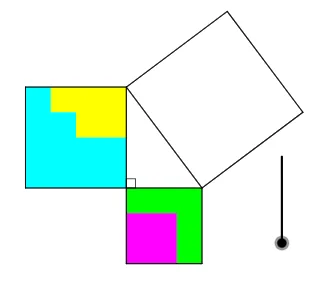
This example demonstrates Loyd’s Squares construction built on the classic 3-4-5 right triangle, visually revealing how nested square regions arise from precise length and similarity relationships. It focuses on right-triangle geometry (the 3-4-5 Pythagorean triple), polygon/square construction, and similarity-driven proportional reasoning. The GeoGebra build uses core commands: Point to define key vertices and auxiliary construction points, Polygon to create the layered square/polygon shapes (e.g., poly1–poly4), Angle to enforce required orientation and right-angle/sector constraints, Midpoint to obtain midpoints for ratio or partition-based steps, Dilate to scale figures between different sizes while preserving geometric relationships, and If to switch between construction cases. The construction relies on objects such as the main triangle points (A, B, C), multiple intermediate points (like D, H, E, I, etc.), and several condition-dependent labeled points to complete the nested square layout. Suitable for middle/high-school geometry instruction, enrichment, and competition-style demonstrations of Pythagorean geometry and transformation-based proofs.
GeoGebra Commands & Parameters
Point(xAxis) → APoint(yAxis) → BPoint(xAxis) → CPolygon(C, A, 4) → poly1, f, g, h, p, D, HPolygon(A, B, 4) → poly2, i, j, k, q, E, IPolygon(B, C, 4) → poly3, l, m, n, r, F, GAngle(A, B, C) → αAngle(B, C, A) → βAngle(C, A, B) → γMidpoint(E, A) → JMidpoint(B, A) → KMidpoint(E, B) → LMidpoint(L, E) → MMidpoint(J, L) → NMidpoint(J, E) → OPolygon(M, O, N, J, K, B) → poly4, m_1, o, n_1, j_1, k_1, bPolygon(M, E, I, A, K, J, N, O) → poly5, m_2, e, i_1, a, k_2, j_2, n_2, o_1Dilate(C, 2 / 3, D) → C'Dilate(D, 1 / 3, A) → D'Dilate(D, 1 / 3, H) → D'_1Polygon(A, D', C', D'_1, H, C) → poly6, a_1, d', c', d'_1, h_1, cPolygon(D, D', C', D'_1) → q1, d, s, t, f_1If(0 < w ≤ 1, Rotate[Polygon[Translate[A, Dilate[H, 1 - w, F] - H], Translate[D', Dilate[H, 1 - w, F] - H], Translate[C', Dilate[H, 1 - w, F] - H], Translate[D'_1, Dilate[H, 1 - w, F] - H], Translate[H, Dilate[H, 1 - w, F] - H], Translate[C, Dilate[H, 1 - w, F] - H]], (w * α), Dilate[H, 1 - w, F]], Rotate[Polygon[Translate[A, F - H], Translate[D', F - H], Translate[C', F - H], Translate[D'_1, F - H], Translate[H, F - H], Translate[C, F - H]], α, F]) → poly7If(2 < w ≤ 3, Rotate[Polygon[Translate[D, Dilate[C', 3 - w, G] - C'], Translate[D', Dilate[C', 3 - w, G] - C'], Translate[C', Dilate[C', 3 - w, G] - C'], Translate[D'_1, Dilate[C', 3 - w, G] - C']], ((w - 2) * α), Dilate[C', 3 - w, G]], Rotate[Polygon[Translate[D, G - C'], Translate[D', G - C'], Translate[C', G - C'], Translate[D'_1, G - C']], α, G]) → q2If(4 < w ≤ 5, Rotate[Polygon[Translate[M, Dilate[M, 5 - w, B] - M], Translate[O, Dilate[M, 5 - w, B] - M], Translate[N, Dilate[M, 5 - w, B] - M], Translate[J, Dilate[M, 5 - w, B] - M], Translate[K, Dilate[M, 5 - w, B] - M], Translate[B, Dilate[M, 5 - w, B] - M]], ((w - 4) * α), Dilate[M, 5 - w, B]], Rotate[Polygon[Translate[M, B - M], Translate[O, B - M], Translate[N, B - M], Translate[J, B - M], Translate[K, B - M], Translate[B, B - M]], α, B]) → poly8If(6 < w ≤ 7, Rotate[Polygon[Translate[M, Dilate[I, 7 - w, C] - I], Translate[E, Dilate[I, 7 - w, C] - I], Translate[I, Dilate[I, 7 - w, C] - I], Translate[A, Dilate[I, 7 - w, C] - I], Translate[K, Dilate[I, 7 - w, C] - I], Translate[J, Dilate[I, 7 - w, C] - I], Translate[N, Dilate[I, 7 - w, C] - I], Translate[O, Dilate[I, 7 - w, C] - I]], ((w - 6) * α), Dilate[I, 7 - w, C]], Rotate[Polygon[Translate[M, C - I], Translate[E, C - I], Translate[I, C - I], Translate[A, C - I], Translate[K, C - I], Translate[J, C - I], Translate[N, C - I], Translate[O, C - I]], α, C]) → poly9
AI Drawing Prompt Reference
Construct Loyd's nested squares on a 3-4-5 right triangle. Start by drawing the right triangle, then construct squares on each of its three sides. Use the midpoints, vertices, and sides of these squares and the original triangle to build a series of nested squares and complex polygons, highlighting similarity and proportional reasoning. Finally, apply rotations to some of the shapes based on the parameter w to demonstrate condition-dependent geometric transformations.
The prompt above was compiled from the original drawing commands and is for reference only.