
Locus of Points from Modulus Equation |z-a|=n|z-b|
Loading the math board and drawing, please wait…
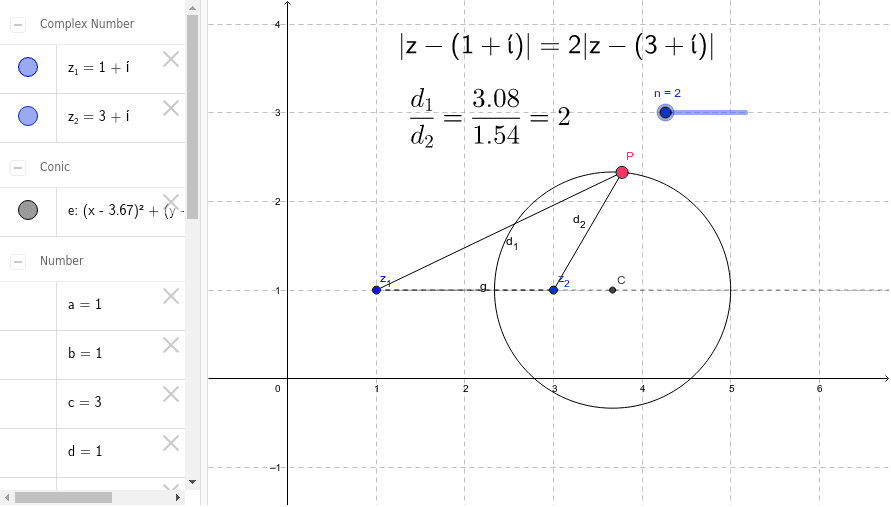
This GeoGebra example dynamically demonstrates the locus of points generated by the complex number equation |z - a| = n|z - b|. As the parameter n varies, the set of complex numbers z satisfying the equation traces a curve on the complex plane, revealing the geometric meaning of a constant ratio of distances to two fixed points. Core mathematical concepts include the modulus of complex numbers, distance between points, the Apollonius circle (when n≠1 the locus is a circle, and when n=1 it becomes a line), and locus equations. Construction details: using basic commands such as Segment, Point, and Ray to define points a, b, and a moving point P; a slider controls the parameter n; distances d_1 and d_2 are measured to verify the equation; and the locus tool generates the final curve g. This is suitable for high school or early college students learning the geometric interpretation of complex numbers, as well as for teaching locus problems in analytic geometry.
GeoGebra Commands & Parameters
Segment(z_1, z_2) → fPoint(e) → PSegment(z_1, P) → d_1Segment(P, z_2) → d_2Ray(z_1, z_2) → g
AI Drawing Prompt Reference
Draw two fixed points and a line segment connecting them on the complex plane, then plot a point moving along the segment. Add a slider to control parameter n, measure the distances from the moving point to the two fixed points, and display their ratio. Trace the path of the moving point when the ratio equals n, showing it forms a circle when n≠1 and a line when n=1, illustrating the geometric meaning of the complex modulus equation.
The prompt above was compiled from the original drawing commands and is for reference only.