
Complex Number Addition: Geometric Vector Sum and Parallelogram Rule
Loading the math board and drawing, please wait…
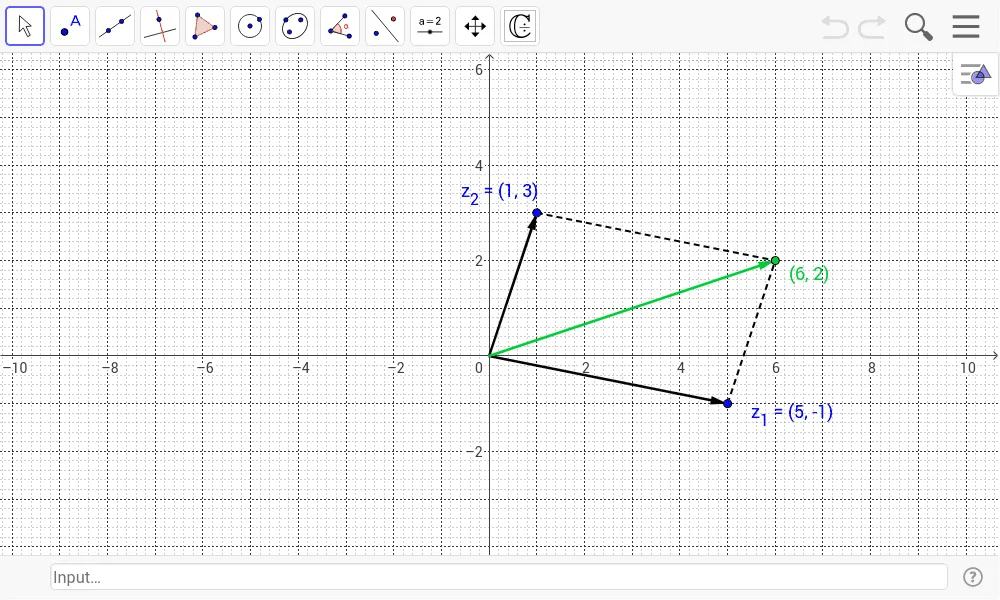
① This GeoGebra example dynamically demonstrates the geometric meaning of adding two complex numbers, showing how their corresponding vectors combine in the complex plane via the parallelogram rule. ② The core mathematical concept is complex addition, treating complex numbers as plane vectors; the sum's endpoint represents the resulting complex number, involving the complex plane, vectors, modulus, and argument. ③ Construction highlights: uses the ComplexVector command to create vectors for complex numbers, ComplexAddition to compute the sum directly, and Segment to connect points forming a parallelogram or triangle; objects include z_1, z_2, u, v, C, z, a, b, allowing real-time dragging to observe changes. ④ Suitable for high school and early college students learning the relationship between complex numbers and vectors, and for teachers as a classroom demonstration to bridge algebraic operations with geometric intuition, also linking to vector space concepts in linear algebra.
GeoGebra Commands & Parameters
ComplexVector(z_2) → uComplexVector(z_1) → vComplexAddition(z_1, z_2) → CComplexVector(C) → zSegment(z_1, C) → bSegment(z_2, C) → a
AI Drawing Prompt Reference
Draw two vectors corresponding to complex numbers on the complex plane and show how their sum combines via the parallelogram rule. First, draw the two vectors, then find their sum and connect each vector's tail to the sum point with line segments to form part of a parallelogram. Observe the dynamic relationship between vector changes and the shape as you drag sliders, visually demonstrating the geometric meaning of complex addition.
The prompt above was compiled from the original drawing commands and is for reference only.