
Liu Hui's Proof of Pyramid Volume by Anthony OR 柯志明
Loading the math board and drawing, please wait…
In collections
Area, Surface Area, Volume, Cross Section, 3D
Volumes and Surface Areas of Pyramids, Cones and Spheres
Volumes and Surface Areas of Pyramids, Cones and Spheres
More about Volumes and Surface Areas
Volumes and Surface Areas of Pyramids, Cones and Spheres
Volumes and Surface Areas of Pyramids, Cones and Spheres
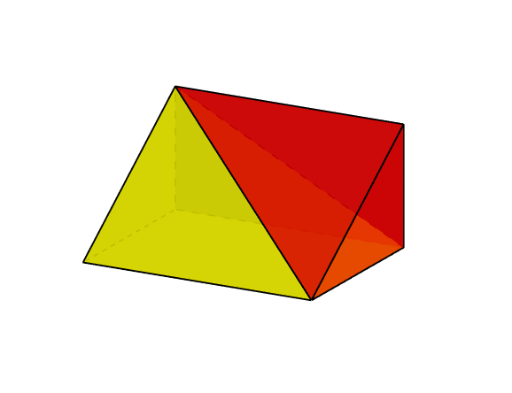
This example demonstrates Liu Hui's (3rd century) proof of the volume of pyramids. It involves core mathematical concepts such as volume formulas, geometric solids, cross-sectional similarity, and the concept of limits. The construction utilizes GeoGebra commands and objects like Vector, Polygon, Prism, Translate, Midpoint, Rotate, and Sequence. Suitable for high school and above students studying solid geometry and volume theorems.
GeoGebra Commands & Parameters
Vector((0, 0, 0), (3, 0, 3)) → vPolygon(A, D, E) → poly1, e, a, dPrism(poly1, B) → b, F_1, edgeBF, edgeFG, edgeBG, F, faceABFD, faceDEGF, faceABGE, faceBFG, edgeAB, edgeDF, edgeEGTranslate(B, Vector[(s * v)]) → B'Translate(C, Vector[(s * v)]) → C'Translate(F, Vector[(s * v)]) → F'Translate(E, Vector[(s * v)]) → E'Translate(Pyramid[Polygon[B, C, F], E], Vector[(s * v)]) → cTranslate(Pyramid[Polygon[A, B, C, D], E], Vector[(0 * v)]) → fMidpoint(A, E) → GMidpoint(D, E) → HMidpoint(B, F) → IMidpoint(C, F) → JMidpoint(A, B) → KMidpoint(D, C) → LMidpoint(E, F) → MMidpoint(B, C) → NMidpoint(A, D) → OMidpoint(M, L) → PMidpoint(M, K) → QRotate(Prism[Polygon[D, L, P, H], O], 0°, zAxis) → gRotate(Prism[Polygon[A, O, G], K], 0°, zAxis) → hMidpoint(K, L) → RRotate(Prism[Polygon[Q, R, N], P], 0°, zAxis) → iTranslate(M, Vector[(s * v)]) → M'Translate(P, Vector[(s * v)]) → P'Translate(Q, Vector[(s * v)]) → Q'Translate(I, Vector[(s * v)]) → I'Translate(J, Vector[(s * v)]) → J'Rotate(Prism[Polygon[I', J', F'], Q'], 0°, zAxis) → jTranslate(N, Vector[(s * v)]) → N'Rotate(Prism[Polygon[Q', N', I'], P'], 0°, zAxis) → kVector(B, Q) → uSequence(Translate[Dilate[list1, 0.5, B'], Vector[(t * u)]], t, 0, 1) → list1'Sequence(Translate[Dilate[list2, 0.5, B], Vector[(t * u)]], t, 0, 1) → list2'Sequence(Translate[Dilate[list1, 0.25, B'], Vector[(t * u / 2)]], t, 0, 3) → list1''Sequence(Translate[Dilate[list2, 0.25, B], Vector[(t * u / 2)]], t, 0, 3) → list2''Sequence(Translate[Dilate[list1, 0.125, B'], Vector[(t * u / 4)]], t, 0, 7) → list1'''Sequence(Translate[Dilate[list2, 0.125, B], Vector[(t * u / 4)]], t, 0, 7) → list2'''Sequence(Translate[Dilate[list1, 0.0625, B'], Vector[(t * u / 8)]], t, 0, 15) → list1''''Sequence(Translate[Dilate[list2, 0.0625, B], Vector[(t * u / 8)]], t, 0, 15) → list2''''Translate(Pyramid[Polygon[B, C, F], E], Vector[(s * v)]) → c'Translate(Pyramid[Polygon[A, B, C, D], E], Vector[(0 * v)]) → f'Rotate(Prism[Polygon[D, L, P, H], O], 0°, zAxis) → g'Rotate(Prism[Polygon[A, O, G], K], 0°, zAxis) → h'Rotate(Prism[Polygon[Q, R, N], P], 0°, zAxis) → i'Rotate(Prism[Polygon[I', J', F'], Q'], 0°, zAxis) → j'Rotate(Prism[Polygon[Q', N', I'], P'], 0°, zAxis) → k'
AI Drawing Prompt Reference
Create a visual proof of the volume of pyramids based on Liu Hui's 3rd-century method. The illustration features a prism with a quadrilateral base and a pyramid, demonstrating how translations and rotations of these geometric solids lead to a series of similar smaller shapes. Use midpoints and vectors to construct the proof, highlighting cross-sectional similarity and the concept of volume, with a step-by-step sequence from basic forms to the final arrangement.
The prompt above was compiled from the original drawing commands and is for reference only.