
Curved Surface Area of Cones by olivia.korum
Loading the math board and drawing, please wait…
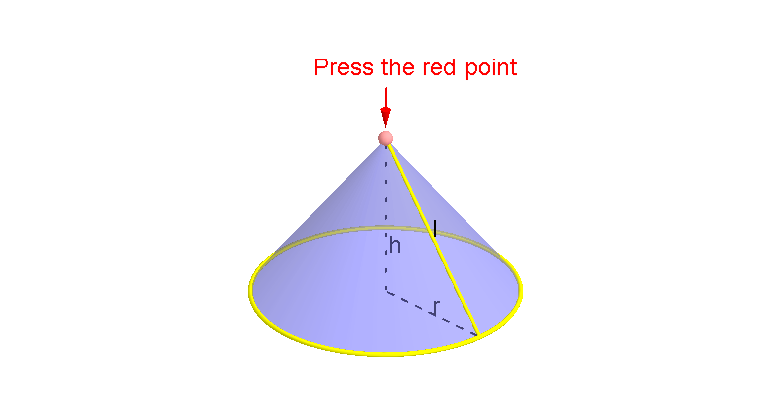
This example demonstrates how to calculate the curved surface area of a cone. Through interactive operations, users can intuitively understand the principle of calculating the surface area. The core mathematical concepts involved include the geometric properties of the cone, the formula for surface area, and related parameters (such as base radius and slant height). Key construction points use GeoGebra commands and objects like Segment, Point, Distance, Sequence, Rotate, CircleArc, Circle, Vector, Cone, etc., to dynamically demonstrate and help learners master the calculation method of surface area. Suitable for high school students studying solid geometry and spatial figures.
GeoGebra Commands & Parameters
Segment(O, H) → aPoint(a) → ADistance(O, A) → OADistance(O, B) → OBSequence((r; γ + (β * i / n)), i, 0, n) → list1Sequence(Polygon[A, Element[list1, i], Element[list1, i + 1]], i, 1, Length[list1] - 1) → list2Segment(O, A) → bRotate(B, γ, a) → B'Rotate(B, (-γ), a) → B'_1Segment(A, B'_1) → cSegment(A, B') → dCircleArc(O, B', B'_1, xOyPlane) → eCircle(O, coneRadius, xOyPlane) → fCircleArc(O, B'_1, B') → gSegment(O, B') → iVector(H + (0, 0, 1), H + (0, 0, 0.2)) → uRotate(B', β / 2, a) → B''Cone(O, H, i) → j, k, l