
Line Integral of a Vector Field in 2-Space
Loading the math board and drawing, please wait…
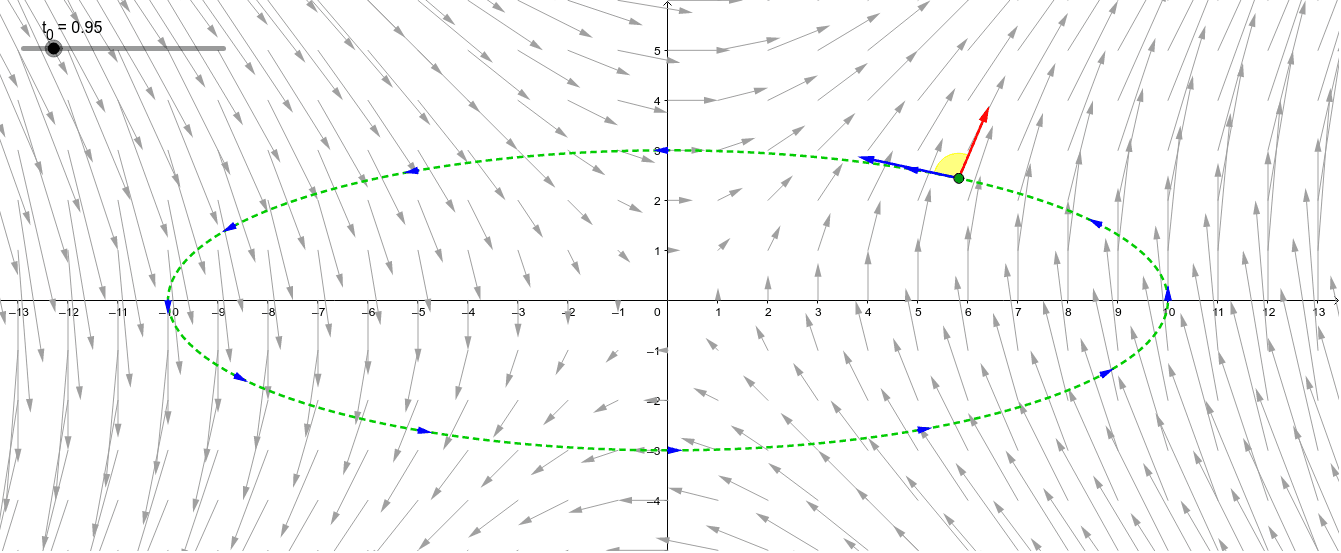
This example demonstrates the line integral of a vector field in 2-space. Key mathematical concepts include vector fields, line integrals, and derivatives. Using GeoGebra commands such as Derivative, Vector, and Sequence, the construction of the vector field and its line integral is illustrated. Suitable for university-level calculus and vector analysis courses.
GeoGebra Commands & Parameters
Derivative(f, x) → f_xDerivative(f, y) → f_yDerivative(c_1) → c_1'Derivative(c_2) → c_2'Vector(P, P + (0.25 * (c_1'(t_0), c_2'(t_0)))) → uSequence(Sequence[Vector[(s, t), (s, t) + (k * (f_x(s, t), f_y(s, t)))], s, -15, 15], t, -10, 10) → vSequence(Vector[(c_1(t), c_2(t)), (c_1(t), c_2(t)) + (k * (f_x(c_1(t), c_2(t)), f_y(c_1(t), c_2(t))))], t, -15, 15) → v_CVector(P, P + (k * (f_x(x(P), y(P)), f_y(x(P), y(P))))) → wAngle(u, w) → αCurveCartesian((c_1(t), c_2(t)), t, 0, (2 * π)) → CSequence(Vector[(c_1(t), c_2(t)), (c_1(t), c_2(t)) + (0.3 / Length[(c_1'(t), c_2'(t))] * (c_1'(t), c_2'(t)))], t, 0, (2 * π), π / 6) → C_v
AI Drawing Prompt Reference
Draw a vector field in 2-space and calculate its line integral. First, define a function f(x, y) and compute its partial derivatives f_x and f_y with respect to x and y. Then, based on the curves c1(t) and c2(t), draw vectors in the vector field and calculate the angles between these vectors and the curves. Finally, draw a curve C and add a sequence of vectors pointing in the direction of the curve's tangent at various points.
The prompt above was compiled from the original drawing commands and is for reference only.