
Law of Reflection Demonstration
Loading the math board and drawing, please wait…
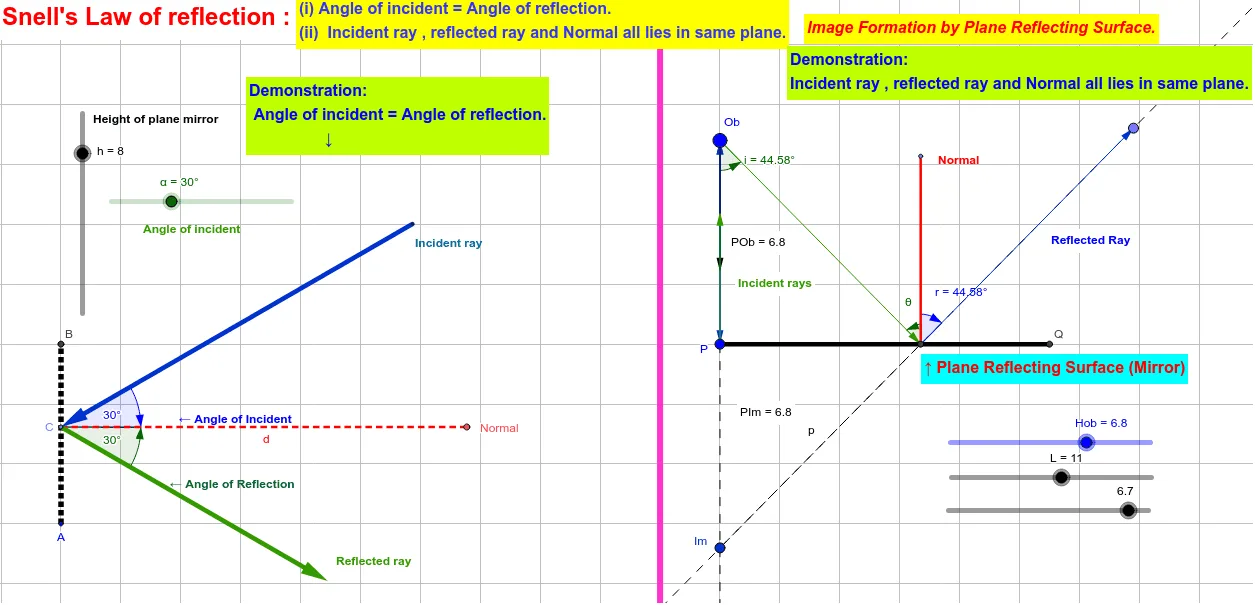
This example demonstrates the law of reflection, involving key mathematical concepts. Using GeoGebra commands such as Segment, Point, and OrthogonalLine, the path of reflected light is clearly shown. Suitable for students at the junior high school level and above.
GeoGebra Commands & Parameters
Segment(A, B) → aPoint(a) → COrthogonalLine(C, a) → bOrthogonalLine(C, a) → cPoint(c) → NormalSegment(C, Normal) → dRotate(Normal, α, C) → D'Angle(Normal, C, D') → βRay(C, D') → eVector(D', C) → uRotate(B, 90° - β, C) → B'Angle(B, C, B') → εRay(C, B') → fLine(B', f) → gPoint(g) → EAngle(E, C, Normal) → ζPoint(g) → FVector(C, F) → vSegment(P, Q) → i_1Vector(Ob, P_1) → wLine(Ob, P_1) → jVector(Ob, P_2) → kOrthogonalLine(P_2, i_1) → lPoint(l) → HSegment(P_2, H) → mPoint(w) → IPoint(k) → JAngle(I, Ob, J) → ηPoint(k) → KPoint(m) → MAngle(M, P_2, K) → θDistance(P_1, Ob) → distanceP1ObLine(P_2, Im) → nSegment(P_2, Im) → pPoint(w) → NVector(P_1, N) → qTranslate(P_1, q) → OVector(P_1, O) → r_1Ray(P_1, Im) → sPoint(n) → RVector(P_2, R) → tPoint(r_1) → SPoint(k) → TAngle(S, Ob, T) → iPoint(r_1) → UVector(Ob, U) → u_1Point(u_1) → VVector(P, V) → v_1Line(W, Z) → f_1Point(m) → A_1Angle(R, P_2, A_1) → rPoint(t) → B_1Distance(P, Ob) → distancePObDistance(P, Im) → distancePIm
AI Drawing Prompt Reference
Draw a diagram of light reflection, including the light source B, reflection point C, reflection surface a, normal b, reflected ray d, reflection angle β, incident ray e, incident angle ε, reflected ray f, reflected surface g, reflection point E, reflection angle ζ, incident ray h, incident point P, reflection surface i, reflection point Q, reflection angle θ, incident ray j, incident point Ob, reflection surface k, reflection point L, reflection angle η, incident ray m, incident point P2, reflection surface n, reflection point Im, reflection angle i, incident ray o, incident point P1, reflection surface p, reflection point N, reflection angle θ, incident ray q, incident point O, reflection surface r, reflection point S, reflection angle θ, incident ray s, incident point R, reflection surface t, reflection point V, reflection angle θ, and incident ray u.
The prompt above was compiled from the original drawing commands and is for reference only.