
Refraction by Different Curved Surfaces
Loading the math board and drawing, please wait…
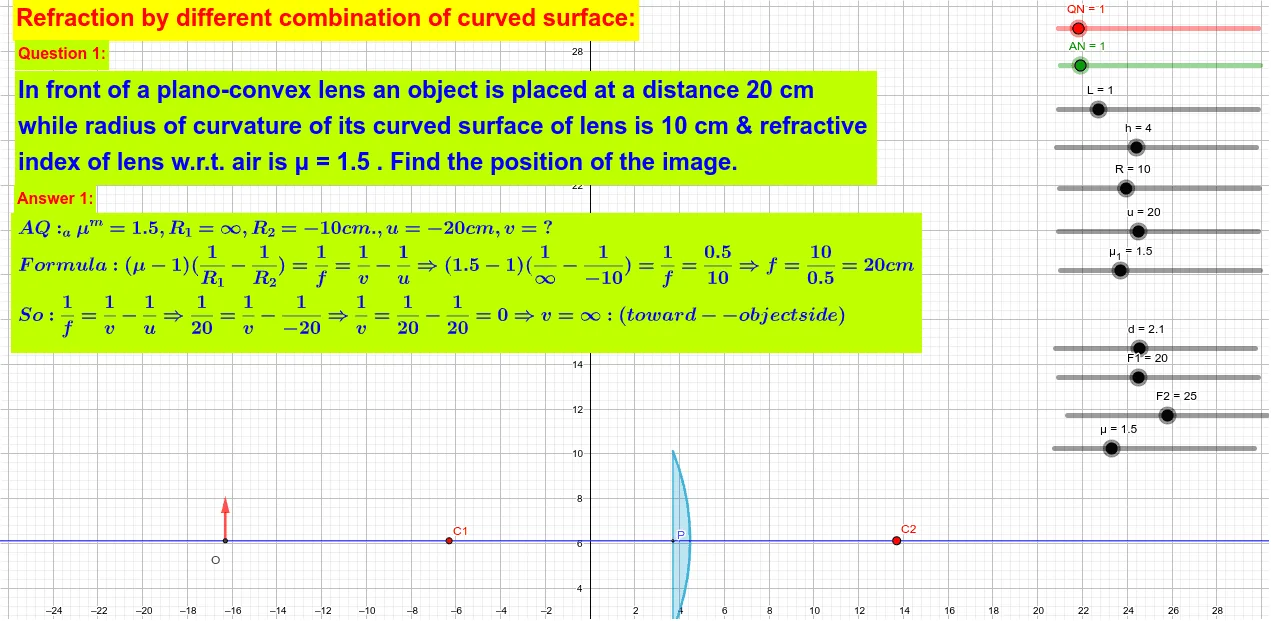
This example demonstrates refraction phenomena under different combinations of curved surfaces. Key mathematical concepts include refraction laws, surface geometry, and probability statistics. Construction involves GeoGebra commands such as Line, CircleArc, Intersect to create surfaces and refraction paths. Suitable for high school or university mathematics courses to understand the integration of optics and geometry.
GeoGebra Commands & Parameters
Line(P, C1) → fCircleArc(C1, B, A) → cSegment(A, B) → gCircleArc(C2, A, B) → d_{2}Intersect(f, xAxis) → CIntersect(f, xAxis) → DIntersect(f, xAxis) → EIntersect(f, xAxis) → FIntersect(d_{2}, f) → G,Line(A, f) → iLine(B, f) → jOrthogonalLine(G, f) → kIntersect(i, k) → HIntersect(k, j) → ISegment(H, I) → lSegment(H, A) → mSegment(I, B) → nVector(O, O') → vLine(O', f) → pIntersect(c, g, 2) → MCircleArc(C2, A, B) → eCircleArc(C3, A, B) → qCircleArc(C2, A, B) → rCircleArc(C1, B, A) → sCircleArc(C2, A1, B1) → tCircleArc(C1, B2, A2) → c_1Segment(A2, A1) → aSegment(B2, B1) → bCircleArc(C1, B2, A2) → d_1CircleArc(C2, A2, B2) → e_1CircleArc(C1, B1, A1) → f_1CircleArc(C2, A1, B1) → g_1CircleArc(C1, B2, A2) → h_1CircleArc(C2, A2, B2) → k_1Intersect(f, xAxis) → NIntersect(f, xAxis) → QIntersect(f, xAxis) → SCircleArc(C12, B1, A1) → p_1CircleArc(C22, A11, B11) → q_1Segment(A1, A11) → i_1Segment(B1, B11) → j_1CircleArc(C1, B2, A2) → r_1CircleArc(C2, A1, B1) → s_1CircleArc(C12, B1, A1) → t_1CircleArc(C22, A11, B11) → c_2Segment(A1, A11) → l_1Segment(B1, B11) → m_1
AI Drawing Prompt Reference
Draw the refraction phenomena with different curved surfaces, including two lines f and c, two arcs d2 and e, and multiple intersection points and segments. Start by drawing line f, then draw arcs c and d2, find their intersections with the x-axis at points C, D, E, and F, draw lines i and j, and their perpendiculars to line f at points H and I, and finally draw segments l, m, and n.
The prompt above was compiled from the original drawing commands and is for reference only.