
Numerical Example of Refraction by a Curved Surface
Loading the math board and drawing, please wait…
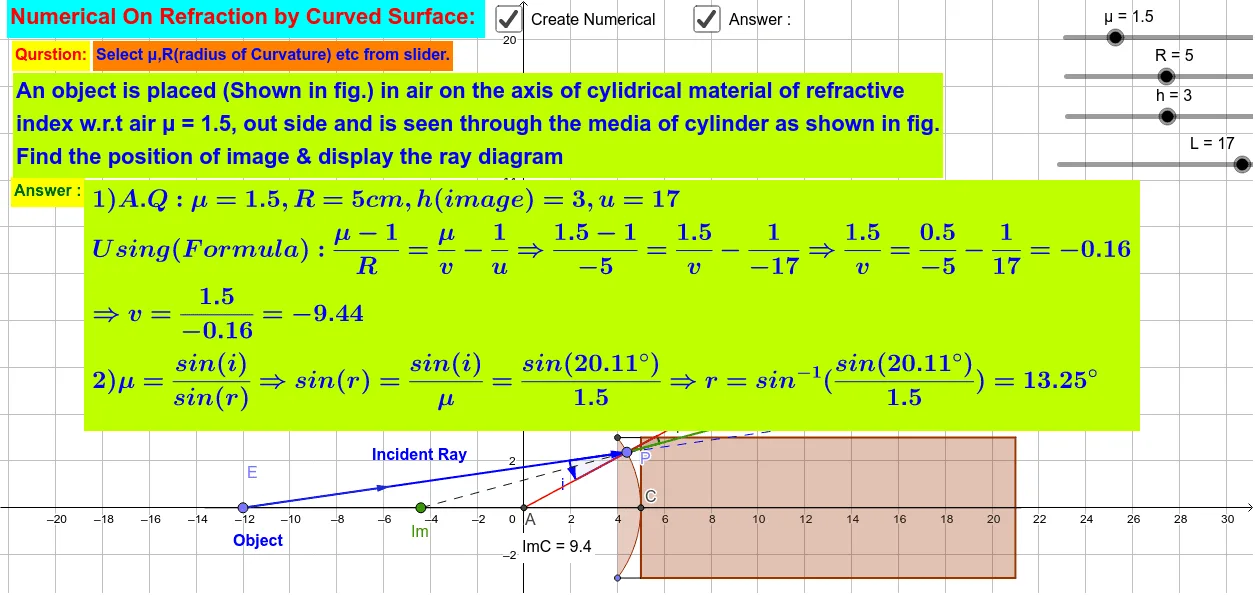
① This example demonstrates the refraction of light rays through a curved (spherical) refractive surface, using geometric construction to precisely locate incident rays, refracted rays, focal points, and image positions. ② Core mathematical concepts include Snell's law of refraction, the spherical surface refraction formula, object-image relationships in geometrical optics, and geometric quantities such as angles, distances, and ratios. ③ Construction highlights: from the summary, GeoGebra commands such as Intersect, Circle, OrthogonalLine, CircleArc, Polygon, Segment, Point, Ray, Angle, Rotate, Vector, and Distance are used. Objects include surface radius R, object distance h, image distance d, refractive index μ, incident angle i, refracted angle r, and many auxiliary points and lines, allowing dynamic adjustment of parameters to observe refraction changes. ④ This is suitable for high school physics or university optics courses explaining spherical surface refraction formulas and graphical methods, and for interdisciplinary teaching of mathematics and physics to help students intuitively understand the geometric expression of refraction laws.
GeoGebra Commands & Parameters
Intersect(xAxis, yAxis) → ACircle(A, R) → cOrthogonalLine(B, xAxis) → fCircleArc(A, B, T) → dIntersect(d, xAxis) → C,Polygon(T_2, T_1, B_1, B_2) → poly1, t_2, t_1, b_1, b_2Segment(T, T_2) → gSegment(B, B_2) → i_1CircleArc(C, T_2, T) → ePoint(d) → PPoint(xAxis) → ERay(E, P) → jRay(A, P) → kAngle(E, P, A) → iPoint(k) → FPoint(j) → GRotate(G, i - r_1, P) → G'Angle(G, P, G') → αRay(P, G') → lVector(P, G') → vAngle(G', P, F) → rPoint(l) → DRay(D, P) → mIntersect(xAxis, m) → ImVector(E, P) → wPoint(w) → HPoint(w) → IVector(E, I) → aDistance(Im, C) → distanceImCPoint(xAxis) → JPoint(xAxis) → KSegment(J, K) → nRay(E, P) → pPoint(p) → MSegment(P, M) → qSegment(P, Im) → sPoint(k) → NSegment(A, N) → t
AI Drawing Prompt Reference
Draw a light path through a spherical refractive surface. First, draw a circle to represent the spherical surface, then draw a vertical line to the x-axis as the optical axis. Next, draw a line from the circle's center to the x-axis, representing the incident ray. Take a point on the circle as the point of incidence, and draw a line from this point to the center, representing the refracted ray. Through rotation and angle calculation, find the intersection of the refracted ray and the x-axis, representing the point of refraction. Finally, use these points and lines to dynamically adjust parameters and observe changes in the refracted ray.
The prompt above was compiled from the original drawing commands and is for reference only.