
Visualizing Centripetal Acceleration in Uniform Circular Motion
Loading the math board and drawing, please wait…
In collections
The Domain of the Time (intuitive kinematics)
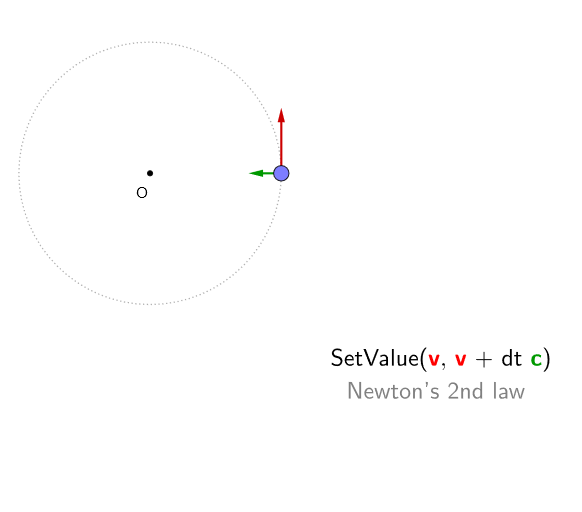
This GeoGebra example demonstrates uniform circular motion (UCM), showing how the centripetal acceleration remains directed toward the center as the velocity direction continuously changes along the circle. It focuses on the geometric and kinematic relationships between position, velocity, and acceleration: key concepts include parameterized circular motion, the direction of centripetal acceleration along the radius, and quantitative links involving angular velocity (ω), linear speed (v), and centripetal acceleration (α). The construction uses Circle to build the track around center O with radius r, Segment to draw the moving point and radius/related vectors, and Translate to update positions during the animation. Angle is used to compute direction relationships, while If controls animation logic and mean supports computed averages or smoothing of displayed quantities. Time parameters (e.g., t, dt, t0, t1, tt) and dynamic objects (e.g., M, P, v, ω, α, A) are labeled to connect the vector geometry with the changing kinematics. Suitable for high-school upper levels through introductory university courses, especially for instruction, visualization-based understanding, and student exploration of circular motion dynamics.
GeoGebra Commands & Parameters
Circle((0, 0), r) → cnSegment(O, M) → sIf(Length[reg] ≟ 1, {reg(1)}, Sequence[reg(k) - reg(k + 1), k, 1, Length[reg] - 1]) → regDifmean(regDif) → TAngle((1, 0), O, Rotate[(1, 0), ω]) → αSegment(O, P) → fCircle(P, (ω * r)) → dTranslate(v, P) → uTranslate(c, P + u) → w
AI Drawing Prompt Reference
Draw a circle centered at the origin with radius r, and place a point M on the circumference to move along it. Draw a line segment OM to represent the position vector, calculate the direction angle α using the angular velocity ω, and draw another circle with P as the center and ω*r as the radius to represent the trajectory of the velocity vector. Finally, use translation to update the display of the velocity and acceleration vectors, illustrating how centripetal acceleration always points towards the center in uniform circular motion.
The prompt above was compiled from the original drawing commands and is for reference only.