
Numerical Methods for Curved Surface Refraction
Loading the math board and drawing, please wait…
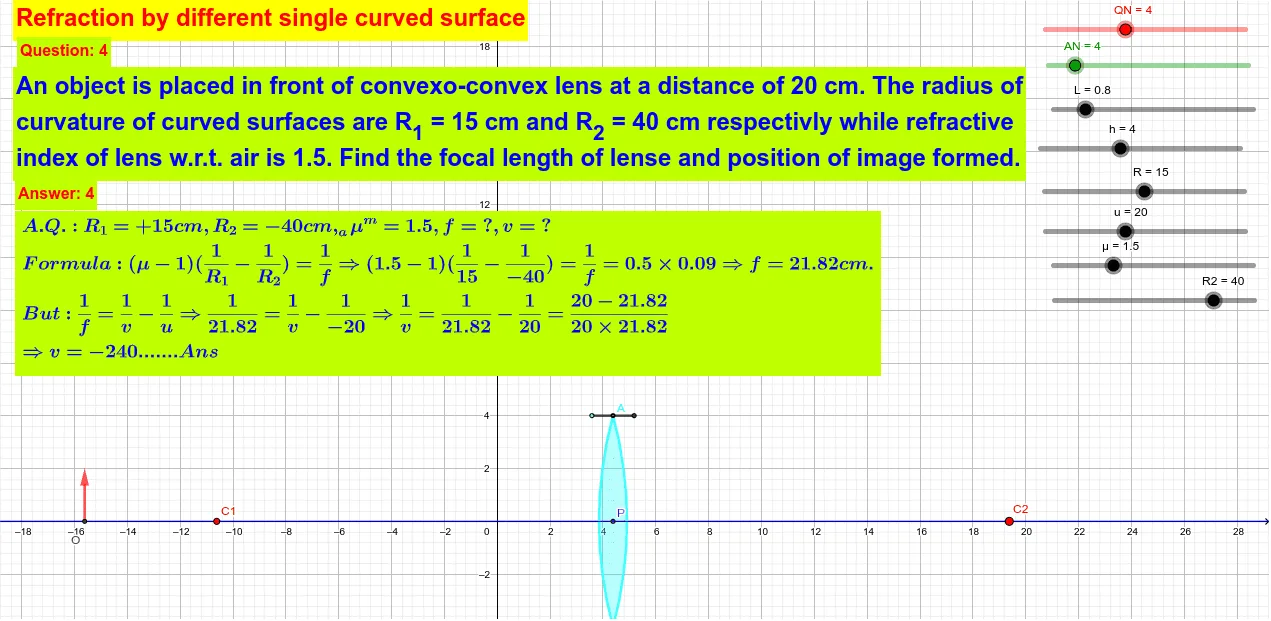
This example demonstrates numerical calculations based on combinations of curved surface refraction. Key mathematical concepts include curved surface refraction, indefinite integrals, and random variables. Construction involves GeoGebra commands like Line, CircleArc, Intersect. Suitable for high school students or college freshmen learning geometry and calculus basics.
GeoGebra Commands & Parameters
Line(P, C1) → fCircleArc(C1, B, A) → cSegment(A, B) → gCircleArc(C2, A, B) → dIntersect(f, xAxis) → CIntersect(f, xAxis) → DIntersect(f, xAxis) → EIntersect(f, xAxis) → FIntersect(d, f) → G,Line(A, f) → iLine(B, f) → jOrthogonalLine(G, f) → kIntersect(i, k) → HIntersect(k, j) → ISegment(H, I) → lSegment(H, A) → mSegment(I, B) → nVector(O, O') → vLine(O', f) → pIntersect(c, g, 2) → JIntersect(c, g, 2) → KIntersect(c, g, 2) → L_{1}Intersect(c, g, 2) → MCircleArc(C2, A, B) → eCircleArc(C3, A, B) → qCircleArc(C2, A, B) → rCircleArc(C1, B, A) → sCircleArc(C2, A1, B1) → tCircleArc(C1, B2, A2) → c_1Segment(A2, A1) → aSegment(B2, B1) → b
AI Drawing Prompt Reference
Draw a geometric illustration showing curved surface refraction, featuring a line intersecting the x-axis at four points and two arcs that intersect both the line and the x-axis. Construct multiple intersection points, line segments, triangles, and quadrilaterals from these elements, adding auxiliary lines and vectors to highlight the relationships and demonstrate the principles of curved surface refraction.
The prompt above was compiled from the original drawing commands and is for reference only.