
Lateral Moves Activity: Vector Translation with Polygons
Loading the math board and drawing, please wait…
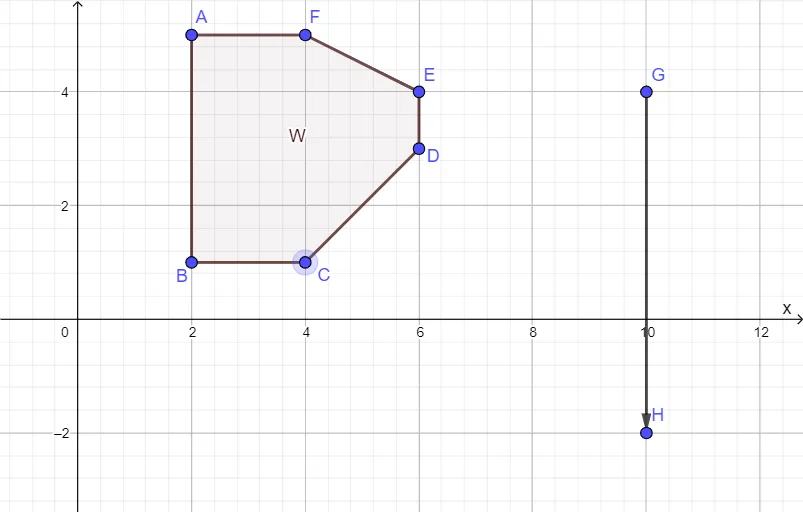
This example demonstrates the idea of “lateral moves” by constructing how a planar geometric figure translates along a given vector: after translation, corresponding vertices and connecting segments retain their structure. Key concepts include vector-based translation (transformation), maintaining geometric relationships under linear shifts, and assembling/connecting vertices to form polygonal shapes. Construction highlights come directly from the provided GeoGebra commands “Polygon, Vector”: using points such as A, B, C, D, E, F, W and sets of corresponding points (a, b, c, d, e, f) to represent the original and translated configurations, driven by vector objects like u. Additional points (e.g., G, H) help organize and verify the correspondence between pre- and post-move edges. Suitable for school-level geometry through early university transformation learning, ideal for illustrating the vector-to-translation link and practicing geometric construction.
GeoGebra Commands & Parameters
Polygon(A, B, C, D, E, F) → W, a, b, c, d, e, fVector(G, H) → u
AI Drawing Prompt Reference
Draw a hexagon ABCDEF first, then translate it along vector GH. Start by drawing the hexagon ABCDEF, then draw vector GH, and finally translate the hexagon ABCDEF using vector GH, ensuring that the corresponding vertices and edges maintain their relationships after the translation.
The prompt above was compiled from the original drawing commands and is for reference only.