
Reflection-Based Translation Practice: Slides, Flips and Spins
Loading the math board and drawing, please wait…
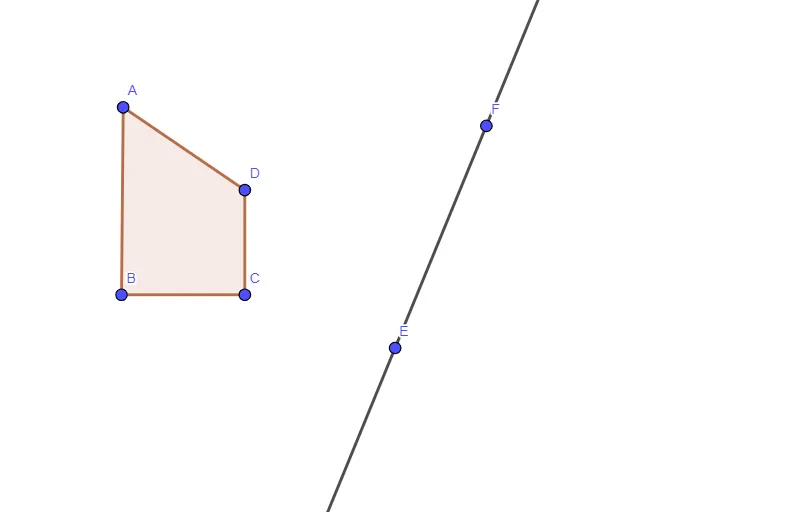
This GeoGebra example demonstrates “slides, flips and spins” by visualizing how planar reflections act on a constructed figure, with translation ideas used to clarify how the relative positions of key points change. It helps learners track corresponding points and line segments after a flip, emphasizing the geometric rule behind reflection (symmetry with respect to an axis) while relating the observed angle/side relationships to broader triangle reasoning. The core concepts include reflection geometry, translation as a position change driven by vectors, and the measurement/relationship perspective behind trigonometric functions (often used to describe angles and derived properties such as those connected to isosceles triangles). Construction-wise, the model relies on GeoGebra commands Polygon and Line, and the specified objects A, B, C, D, q1, a, b, c, d, E, F, f to define the original and transformed key points and edges. Suitable for middle to high school geometry lessons (transformations and symmetry), classroom demonstrations, and self-study with interactive construction and verification.
GeoGebra Commands & Parameters
Polygon(A, B, C, D) → q1, a, b, c, dLine(E, F) → f
AI Drawing Prompt Reference
Draw a figure consisting of a quadrilateral ABCD and a line segment EF. ABCD is the original shape, and EF connects two points. The construction order is to draw the quadrilateral ABCD first, then the line segment EF. This figure helps illustrate geometric relationships such as symmetry and angle changes.
The prompt above was compiled from the original drawing commands and is for reference only.