
Kayseri-Sahibiye Madrassa Geometric Construction by chris cambré
Loading the math board and drawing, please wait…
In collections
Fatin Uluengin - muqarnas
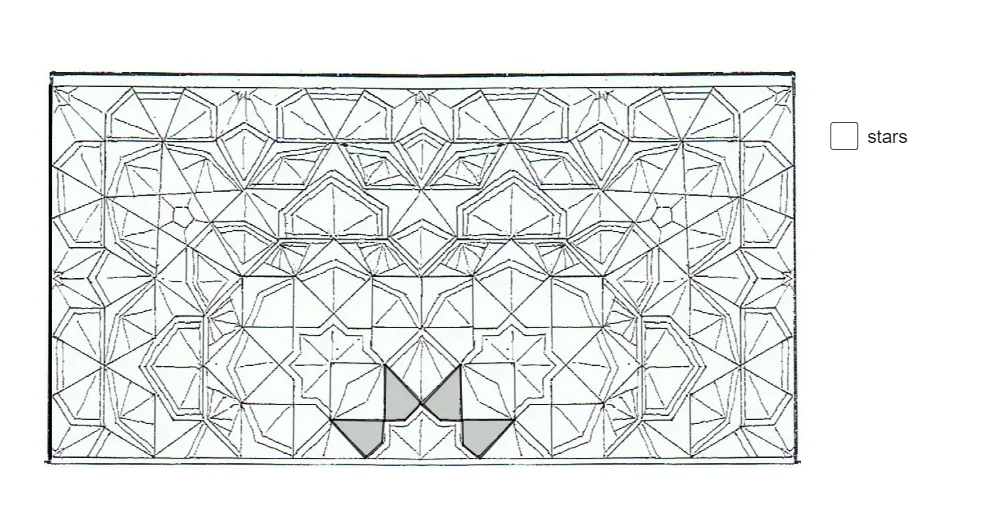
This example demonstrates the geometric construction process of the Kayseri-Sahibiye Madrassa. It involves core mathematical concepts such as polygons, vectors, transformations, and geometric construction. Key construction steps include using commands like Point, ConstructionStep, Polygon, Segment, Intersect, Mirror, Vector, and Translate in GeoGebra. Suitable for high school students learning geometric construction techniques.
GeoGebra Commands & Parameters
Point(xAxis) → AConstructionStep() → stapPoint(xAxis) → BPolygon(A, B, C, D) → vierhoek1, a, b, c, dPoint(yAxis) → ESegment(E, F) → fIntersect(a, f) → GPoint(c) → H_1Segment(H_1, G) → sSegment(D, G) → gIntersect(c, f) → HSegment(A, H) → hPoint(d) → ISegment(I, J) → iPoint(c) → KPoint(a) → LSegment(K, L) → jMirror(G, g) → G'Intersect(g, h) → NPoint(d) → PPoint(b) → MSegment(J, M) → kPoint(c) → OPoint(a) → RSegment(O, R) → lSegment(I, K) → mSegment(K, J) → pSegment(I, L) → qSegment(L, J) → nSegment(L, J) → rMirror(afbeelding5, yAxis) → afbeelding5'Point(a) → I_1Point(s) → M_1Polygon(I_1, J_1, R_1, S_1, T_1, U_1, V_1, W_1, K_1, L_1, M_1, N_1, O_1, P_1, Q_1, E_1) → veelhoek1, t, m_1, n_1, p_1, q_1, r_1, s_1, t_1, e, f_1, g_1, h_1, i_1, j_1, k_1, l_1Polygon(A_2, B_2, C_2, D_2, E_2, F_2, G_2, H_2, I_2, J_2) → veelhoek2, a_2, j_2, b_2, c_2, d_2, e_2, f_2, g_2, h_2, i_2Mirror(A_2, yAxis) → K_2Mirror(B_2, yAxis) → L_2Mirror(C_2, yAxis) → M_2Mirror(D_2, yAxis) → N_2Mirror(E_2, yAxis) → O_2Mirror(F_2, yAxis) → P_2Mirror(G_2, yAxis) → Q_2Mirror(H_2, yAxis) → R_2Mirror(I_2, yAxis) → S_2Mirror(J_2, yAxis) → T_2Polygon(K_2, L_2, M_2, N_2, O_2, P_2, Q_2, R_2, S_2, T_2) → veelhoek2', k_2, t_2, l_2, m_2, n_2, o_2, p_2, q_2, r_2, s_2Polygon(U_2, V_2, W_2, Z_2, A_3, B_3, C_3) → veelhoek3, u_2, v_2, w_2, z_2, a_3, b_3, c_3Vector(D_3, E_3) → uTranslate(U_2, u) → F_3Translate(V_2, u) → G_3Translate(W_2, u) → H_3Translate(Z_2, u) → I_3Translate(A_3, u) → J_3Translate(B_3, u) → K_3Translate(C_3, u) → L_3Polygon(F_3, G_3, H_3, I_3, J_3, K_3, L_3) → veelhoek3', f_3, g_3, h_3, i_3, j_3, k_3, l_3Translate(U_2, Vector[(-u)]) → M_3Translate(V_2, Vector[(-u)]) → N_3Translate(W_2, Vector[(-u)]) → O_3Translate(Z_2, Vector[(-u)]) → P_3Translate(A_3, Vector[(-u)]) → Q_3Translate(B_3, Vector[(-u)]) → R_3Translate(C_3, Vector[(-u)]) → S_3Polygon(M_3, N_3, O_3, P_3, Q_3, R_3, S_3) → veelhoek3'_1, m_3, n_3, o_3, p_3, q_3, r_3, s_3