
Isosceles Triangle Rotation Fractal Animation
Loading the math board and drawing, please wait…
In collections
Congruence (CO) Cluster
Congruence (Vol 2)
CCSS High School: Geometry (Congruence) Volume 2
CCSS High School: Geometry (Congruence) Volume 2
CCSS High School: Geometry (Congruence) Volume 2
Geometry (Congruence) Volume 2
CCSS High School: Geometry (Congruence) Volume 2
CCSS High School: Geometry (Congruence) Volume 2
CCSS High School: Geometry (Congruence) Volume 2
CCSS High School: Geometry (Congruence) Volume 2
CCSS High School: Geometry (Congruence) Volume 2
CCSS High School: Geometry (Congruence) Volume 2
CCSS High School: Geometry (Congruence) Volume 2
Gail LeBlancCCSS High School: Geometry (Congruence) Volume 2
CCSS High School: Geometry (Congruence) Volume 2
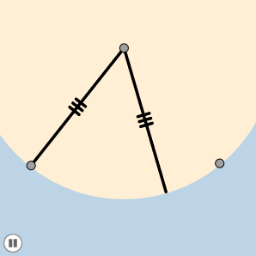
① This example demonstrates an animation of a fractal boundary generated by repeatedly rotating, dilating, and translating a set of isosceles triangles. ② Core mathematical concepts include properties of isosceles triangles, polygon perimeters, rotation transformations, similarity dilations, and fractal geometry. ③ Construction uses GeoGebra commands Circle, Intersect, CircleArc, Point, Dilate, Segment, Angle, Rotate, Midpoint, Polygon, Vector, Translate, and Line to create circles, arcs, segments, vectors, and polygons, then applies successive rotations, dilations, and translations to produce the iterative figure. ④ Suitable for high‑school geometry electives, university geometric modeling courses, and GeoGebra animation workshops.
GeoGebra Commands & Parameters
Circle(A, B) → cIntersect(c, q) → O, PCircleArc(A, O, P) → dPoint(d) → CCircleArc(A, C, P) → ePoint(e) → DDilate(A, If[0 < j ≤ 1, 1 - j, 0], C) → A'Segment(A, A') → aAngle(C, A, D) → αRotate(A, If[1 < j ≤ 2, ((j - 1) * α), α], A) → A'_1Rotate(A', If[1 < j ≤ 2, ((j - 1) * α), α], A) → A''Segment(A'_1, A'') → a'Segment(A, C) → bSegment(C, D) → fSegment(D, A) → gMidpoint(f) → ESegment(A, E) → hMidpoint(h) → FSegment(A, F) → iSegment(F, E) → kCircle(A, (0.35 * i)) → pCircle(E, (0.15 * Distance[D, E])) → rIntersect(r, f, 2) → GIntersect(r, h, 1) → HIntersect(r, f, 1) → IIntersect(p, b, 1) → JIntersect(p, h, 1) → KIntersect(p, g, 1) → LCircle(A, B) → c_1Dilate(C, If[2 < j ≤ 3, 3 - j, 0], D) → C'Segment(C, C') → lPolygon(C, D, A) → poly1, a_1, c_2, d_1Circle(C, (0.2 * Distance[D, E])) → e_1Intersect(e_1, b) → M,Intersect(e_1, f) → N,Dilate(A, If[3 < j ≤ 4, 4 - j, 0], F) → A'_2Dilate(F, If[5 < j ≤ 6, 6 - j, 0], E) → F'Dilate(E, If[6 < j ≤ 7, 7 - j, 0], D) → E'Rotate(E, If[7 < j ≤ 8, ((j - 7) * π), 3.141592653589793], E) → E'_1Rotate(E', If[7 < j ≤ 8, ((j - 7) * π), 3.141592653589793], E) → E''Dilate(C, If[9 < j ≤ 10, 10 - j, 0], D) → C'_1Vector(C, C'_1) → uAngle(E, C, A) → βSegment(C, A) → sSegment(D, A) → f_1Midpoint(s) → QMidpoint(f_1) → RDilate(C, If[3 < j ≤ 4, 4 - j, 0], Q) → C'_2Dilate(D, If[3 < j ≤ 4, 4 - j, 0], R) → D'Segment(C, C'_2) → i_1Segment(D, D') → j_1Rotate(C, If[4 < j ≤ 5, ((-(j - 4)) * π), (-π)], Q) → C'_3Rotate(C'_2, If[4 < j ≤ 5, ((-(j - 4)) * π), (-π)], Q) → SSegment(C'_3, S) → l_1Rotate(D, If[4 < j ≤ 5, ((j - 4) * π), π], R) → D'_1Rotate(D', If[4 < j ≤ 5, ((j - 4) * π), π], R) → D''Segment(D'_1, D'') → mDilate(C, If[5 < j ≤ 6, 6 - j, 0], R) → C'_4Segment(C, C'_4) → nDilate(D, If[6 < j ≤ 7, 7 - j, 0], Q) → D'_2Segment(D, D'_2) → tDilate(R, If[7 < j ≤ 8, 8 - j, 0], D) → R'Vector(R, R') → vTranslate(C, v) → C'_5Translate(C'_4, v) → TSegment(C'_5, T) → n'Line(C, R) → g_1Line(D, g_1) → h_1Point(h_1) → UAngle(Q, D, U) → δRotate(C'_5, If[8 < j ≤ 9, ((-(j - 8)) * δ), (-δ)], D) → VRotate(T, If[8 < j ≤ 9, ((-(j - 8)) * δ), (-δ)], D) → T'Segment(V, T') → n''