
Triangles, Squares and Unexpected Area Identities
Loading the math board and drawing, please wait…
In collections
Euclidean Geometry
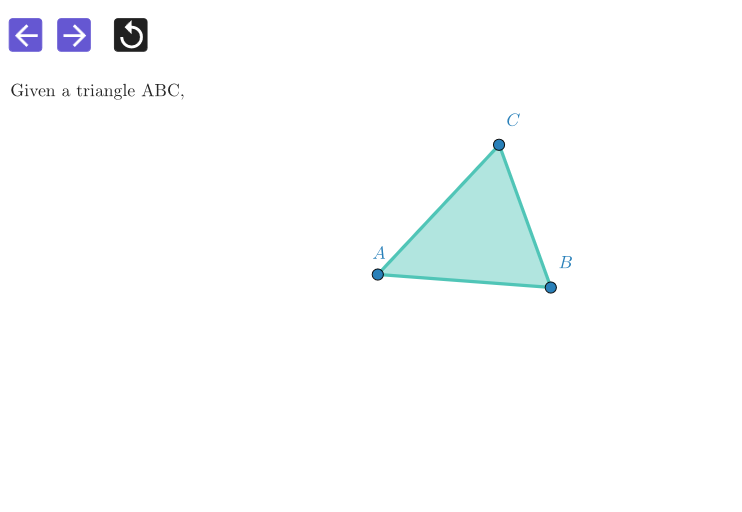
This example demonstrates an unexpected area relationship arising from a simple geometric construction. It links triangles and squares (and related quadrilaterals) through geometric transformations, emphasizing area calculations, congruence ideas, and invariants under transformations such as rotation. By carefully constructing key points via circle intersections and assembling regions with polygons, the app reveals why the areas match (or correspond) in a non-obvious way and invites students to justify the result with geometric reasoning and proof. Construction uses GeoGebra commands Point, Circle, PointIn, and Polygon, along with constructed polygonal regions (e.g., quadrilateral pieces built from points like A, B, C, D, E) to compare and track the relevant areas while interactive elements/animations help students explore the configuration. Suitable for middle/high-school geometry enrichment and contest preparation, especially when teaching geometric construction, congruence, and area invariance.
GeoGebra Commands & Parameters
Point(xAxis) → PEEPSTCircle(O, 1.75) → peepPointIn(peep) → APointIn(peep) → CPointIn(peep) → BPolygon({A, B, C}) → t1Polygon(B, A, 4) → quadrAC, g, h, i, j, D, EPolygon(C, B, 4) → quadrBC, l, m, n, p, F, GPolygon(A, C, 4) → quadrAB, q, r, s, t, H, IPolygon({A, D, I}) → trADPolygon({C, H, G}) → trCHPolygon({B, F, E}) → trBF
AI Drawing Prompt Reference
Draw a plane figure starting with a chosen center point and a circle around it. Mark three points on the circle and connect them to form a triangle. Using the triangle’s vertices as anchors, construct three outer polygonal quadrilateral pieces by forming regions along the sides (each piece uses the two corresponding triangle vertices plus the appropriate additional points determined by the circle-based intersections). From these quadrilateral pieces, highlight three specific triangular regions built from selected triangle vertices together with corresponding vertices inside the quadrilateral pieces. Present the triangle, the three quadrilateral regions, and the three emphasized triangles together so the area relationships can be visually compared.
The prompt above was compiled from the original drawing commands and is for reference only.