
Is VAR Exact? Symmetry and Angle Measurement via GeoGebra Construction
Loading the math board and drawing, please wait…
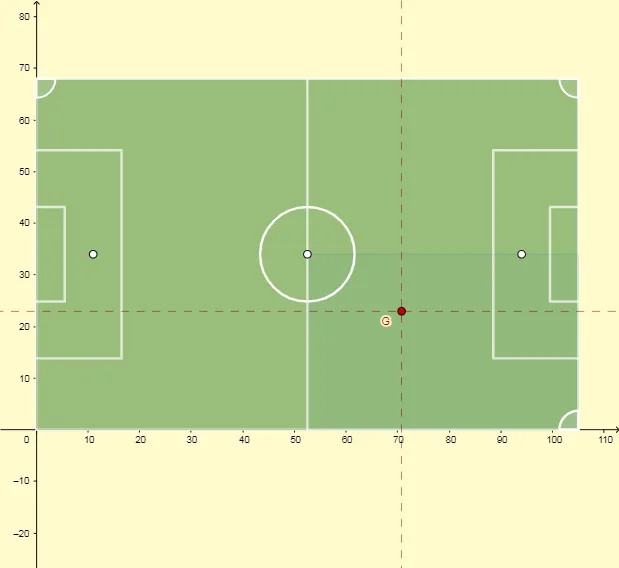
This example tests whether a “VAR”-related geometric statement (typically an angle or correspondence involving points V, A, R) is exact by constructing mirrored/rotated configurations and comparing the resulting angle and distance measures within the same dynamic setup. The key math ideas include geometric construction techniques (intersections, perpendiculars, midpoints, angle bisectors), circle geometry, and symmetry/transformations such as reflection (Mirror) and rotation (Rotate). It also leverages measurement tools—Angle and Distance—to verify whether the constructed configuration satisfies the intended equality precisely. Construction highlights drawn from the provided summary: Intersect to create key intersection points; Midpoint and LineBisector for midpoints and angle bisectors; OrthogonalLine for perpendicular lines; Circle plus Segment/PolyLine/Polygon to build circular and polygonal structures; Mirror/Rotate to generate corresponding points; and Angle and Distance to compare the “VAR” geometric quantities directly. Suitable for middle/high school students, geometry enrichment, and classroom demonstrations of how dynamic geometry can be used to check exactness of a conjecture.
GeoGebra Commands & Parameters
Intersect(xAxis, yAxis) → ALineBisector(A, B) → fPolygon(C, A, B, D) → q1, c, a, b, dIntersect(f, d) → EIntersect(f, a) → FSegment(E, F) → gMidpoint(D, B) → KOrthogonalLine(K, b) → iIntersect(g, i) → JPolygon(K, J, F, B) → q2, k_1, j_1, f_1, b_1Circle(J, 9.15) → kMirror(L, K) → L'Midpoint(M, L') → NMirror(L, N) → L'_{1}PolyLine(L, M, L'_{1}, L') → jMirror(O, K) → O'Mirror(P, i) → P'PolyLine(O, P, P', O') → lMirror(E, d) → E'Mirror(F, d) → F'Mirror(Q, g) → Q'Mirror(L, g) → L'_{2}Mirror(M, g) → M'Mirror(L'_{1}, g) → RMirror(L', g) → L''PolyLine(L'_{2}, M', R, L'') → j'Mirror(O, g) → O'_{1}Mirror(P, g) → P'_{1}Mirror(P', g) → P''Mirror(O', g) → O''PolyLine(O'_{1}, P'_{1}, P'', O'') → l'Circle(Q, 9.15) → qAngle(O'_{1}, C, E') → δPointIn(q2) → GIntersect(eq1, a) → HRotate(G, (-(α_{1}°)), H) → G'Angle(G', H, G) → αDistance(G, G') → distanceGG'Line(G', H) → mAngle(D, B, A) → βAngle(C, D, B) → γ
AI Drawing Prompt Reference
Draw a geometric figure involving a quadrilateral formed by four points and two triangles, showcasing symmetry through midpoints, angle bisectors, perpendiculars, and circles. Start with the intersection of coordinate axes, then construct a quadrilateral. Find the midpoint and angle bisector of one side. Use these to create two new triangles and draw a circle. Generate symmetric configurations using mirror and rotation operations, and compare angles and distances with measurement tools to verify the geometric statement's accuracy.
The prompt above was compiled from the original drawing commands and is for reference only.