
Interactive Geometry of Circle Circumference and Radius
Loading the math board and drawing, please wait…
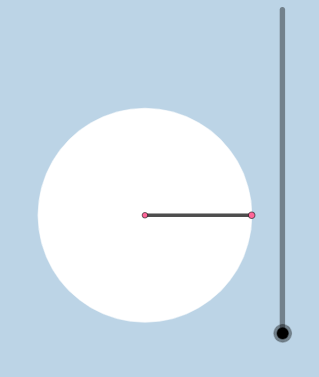
This example demonstrates how a circle’s circumference is represented and how the key radius-related measures correspond as the circle’s scale changes. It centers on fundamental circle concepts: radius, circle arcs and perimeter (circumference), and the role of angles (especially central angles) in relating geometric quantities. Construction highlights include creating segments that represent the radius (e.g., r and related objects) with Segment, building the circle and relevant arcs with Circle and CircleArc, and defining and locating critical points using Point and Intersect. Auxiliary lines are formed with Line and OrthogonalLine to support angle or distance construction. The model uses geometric transformations such as Rotate, Translate, Dilate, and Mirror to generate corresponding objects (e.g., primed duplicates) while preserving the intended geometric relationships. Angle markers are added via Angle (e.g., α) to connect the construction to central-angle geometry. Conditional logic (If) and vectors (Vector) are used to drive interactive behavior and linked annotations. Suitable for middle school geometry and early high school instruction, as well as exploratory learning and classroom demonstration.
GeoGebra Commands & Parameters
Segment((0, 0), (r, 0)) → fRotate((r, 0), 1, (0, 0)) → ARotate((r, 0), 2, (0, 0)) → BRotate((r, 0), 3, (0, 0)) → CRotate((r, 0), 4, (0, 0)) → DRotate((r, 0), 5, (0, 0)) → ERotate((r, 0), -1, (0, 0)) → FRotate(f, If[0 < a ≤ 1, ((-a) * pi / 2), ((-pi)) / 2], (r, 0)) → f'Rotate(G, If[1.5 < a ≤ 2.5, a - 1.5, 1], (0, 0)) → G'CircleArc((0, 0), G, G') → cCircle(G', r - c) → dLine((0, 0), G') → gOrthogonalLine(G', g) → hIntersect(d, h, 2) → HSegment(G', H) → iDilate(G, If[3 < a ≤ 4, 4 - a, 0], A) → G'_{1}Vector(G, G'_{1}) → uTranslate(f, u) → f'_{1}Line((0, 0), A) → jOrthogonalLine(A, j) → kPoint(p) → IPoint(k) → JAngle(J, A, I) → αRotate(f'_{1}, If[3 < a ≤ 4, ((-(a - 3)) * α), (-α)], G'_{1}) → lRotate(A, If[4 < a ≤ 5, a - 4, 1], (0, 0)) → A'CircleArc((0, 0), A, A') → eCircle(A', r - e) → qLine((0, 0), A') → mOrthogonalLine(A', m) → nIntersect(q, n, 2) → KSegment(A', K) → sDilate((0, 0), If[5.5 < a ≤ 6.5, 6.5 - a, 0], B) → LVector(M, L) → vTranslate(f, v) → f'_{2}Line(M, B) → bOrthogonalLine(B, b) → f_1Point(t) → NPoint(f_1) → OAngle(O, B, N) → βRotate(f'_{2}, If[5.5 < a ≤ 6.5, ((-(a - 5.5)) * β), (-β)], L) → g_1Rotate(B, If[6.5 < a ≤ 7.5, a - 6.5, 1], (0, 0)) → B'CircleArc(M, B, B') → c_1Line(M, B') → h_1OrthogonalLine(B', h_1) → i_1Circle(B', r - c_1) → d_1Intersect(d_1, i_1, 2) → PDilate(M, If[8 < a ≤ 9, 9 - a, 0], C) → M'Vector(M, M') → wTranslate(f, w) → f'_{3}Line(M, C) → k_1OrthogonalLine(C, k_1) → l_1Point(p_1) → QPoint(l_1) → RAngle(R, C, Q) → γRotate(f'_{3}, If[8 < a ≤ 9, ((-(a - 8)) * γ), (-γ)], M') → m_1Rotate(C, If[9 < a ≤ 10, a - 9, 1], M) → C'CircleArc(M, C, C') → e_1Line(M, C') → n_1OrthogonalLine(C', n_1) → q_1Circle(C', r - e_1) → r_1Intersect(r_1, q_1) → S, B_1Intersect(d_1, i_1, 1) → TDilate(M, If[10.5 < a ≤ 11.5, 11.5 - a, 0], D) → M'_{1}Vector(M, M'_{1}) → u_1Translate(f, u_1) → f'_{4}Line(M, D) → a_1OrthogonalLine(D, a_1) → b_1Point(b_1) → UPoint(t_1) → VAngle(U, D, V) → δRotate(f'_{4}, If[10.5 < a ≤ 11.5, ((-(a - 10.5)) * δ), (-δ)], M'_{1}) → f_2Rotate(D, If[11.5 < a ≤ 12.5, a - 11.5, 1], M) → D'CircleArc(M, D, D') → c_2Line(M, D') → g_2OrthogonalLine(D', g_2) → h_2Circle(D', r - c_2) → d_2Intersect(d_2, h_2, 2) → WSegment(D', W) → i_2Intersect(d_2, h_2, 1) → ZRotate(M, If[13 < a ≤ 14, ((a - 13) * pi / 2), pi / 2], G) → M'_{2}Segment(G, M'_{2}) → j_2If(x(P) ≤ x(T), P, T) → A_1Segment(B', A_1) → j_1If(y(B_1) < y(S), B_1, S) → C_1Segment(C', C_1) → s_1Rotate(G, If[14 < a ≤ 15, (-(a - 14)), -1], M) → G'_{2}CircleArc(M, G'_{2}, G) → e_2Line(M, G'_{2}) → k_2Circle(G'_{2}, r - e_2) → p_2OrthogonalLine(G'_{2}, k_2) → l_2Intersect(p_2, l_2) → D_1, E_1If(y(D_1) ≤ y(E_1), D_1, E_1) → F_1Segment(G'_{2}, F_1) → m_2Rotate(D, 1, M) → D'_{1}Rotate(G, 0.5) → G'_{3}Rotate(G, 1.5) → G'_{4}Rotate(G, 2.5) → G'_{5}Rotate(G, 3.5) → G'_{6}Rotate(G, 4.5) → G'_{7}Rotate(G, -0.5) → G'_{8}Segment(G_1, G) → n_2Circle(G_1, n_2 / 7) → q_2Intersect(q_2, n_2, 1) → H_1Mirror(G_1, H_1) → I_1Mirror(H_1, I_1) → J_1Mirror(I_1, J_1) → K_1Mirror(J_1, K_1) → L_1Mirror(K_1, L_1) → M_1Dilate(G_1, If[16 < a ≤ 17, 17 - a, 0], H_1) → N_1Segment(G_1, N_1) → r_2Rotate(G_1, If[17 < a ≤ 18, ((a - 17) * pi), pi], H_1) → O_1Rotate(N_1, If[17 < a ≤ 18, ((a - 17) * pi), pi], H_1) → P_1Segment(O_1, P_1) → s_2Rotate(O_1, If[18 < a ≤ 19, ((a - 18) * pi), pi], I_1) → Q_1Rotate(P_1, If[18 < a ≤ 19, ((a - 18) * pi), pi], I_1) → R_1Segment(Q_1, R_1) → t_2Rotate(Q_1, If[19 < a ≤ 20, ((a - 19) * pi), pi], J_1) → S_1Rotate(R_1, If[19 < a ≤ 20, ((a - 19) * pi), pi], J_1) → T_1Segment(S_1, T_1) → a_2Rotate(S_1, If[20 < a ≤ 21, ((a - 20) * pi), pi], K_1) → U_1Rotate(T_1, If[20 < a ≤ 21, ((a - 20) * pi), pi], K_1) → V_1Segment(U_1, V_1) → b_2Rotate(U_1, If[21 < a ≤ 22, ((a - 21) * pi), pi], L_1) → W_1Rotate(V_1, If[21 < a ≤ 22, ((a - 21) * pi), pi], L_1) → Z_1Segment(W_1, Z_1) → f_3Rotate(W_1, If[22 < a ≤ 23, ((a - 22) * pi), pi], M_1) → A_2Rotate(Z_1, If[22 < a ≤ 23, ((a - 22) * pi), pi], M_1) → B_2Segment(A_2, B_2) → g_3Dilate(I_1, If[24 < a ≤ 25, 25 - a, 0], F) → C_2Vector(I_1, C_2) → v_1Translate(O_1, v_1) → D_2Translate(P_1, v_1) → E_2Segment(D_2, E_2) → h_3Translate(G_1, v_1) → F_2Translate(N_1, v_1) → G_2Segment(F_2, G_2) → i_3Line(G_1, F) → j_3OrthogonalLine(F, j_3) → k_3Line(F, n_2) → l_3Point(l_3) → H_2Point(k_3) → I_2Angle(H_2, F, I_2) → εRotate(D_2, If[24 < a ≤ 25, ((a - 24) * ε), ε], D_2) → J_2Rotate(E_2, If[24 < a ≤ 25, ((a - 24) * ε), ε], D_2) → K_2Rotate(F_2, If[24 < a ≤ 25, ((a - 24) * ε), ε], D_2) → L_2Rotate(G_2, If[24 < a ≤ 25, ((a - 24) * ε), ε], D_2) → M_2Segment(J_2, L_2) → m_3Rotate(F, If[25 < a ≤ 26, ((-(a - 25)) * ((2 * pi) - 6)), 6 - (2 * pi)], G_1) → F'CircleArc(G_1, F', F) → c_3Line(G_1, F') → n_3OrthogonalLine(F', n_3) → p_3Intersect(p_3, eq3) → N_2Ray(F', N_2) → q_3Point(q_3) → O_2CircleArc(G_1, D'_{1}, F) → d_3Circle(F', d_3 - c_3) → e_3Intersect(e_3, q_3, 1) → P_2Segment(F', P_2) → r_3
AI Drawing Prompt Reference
Draw a circle to illustrate the relationship between its radius, arcs, and circumference. Start with a horizontal segment from the center as the radius, then rotate it multiple times around the center to get equally spaced points. Connect these points to form the circle's circumference and draw arcs between them. Use rotations and scaling to create multiple copies of the circle, and construct angle relationships with auxiliary and perpendicular lines. Label key angles and use vectors to drive translations of certain objects. The final image should clearly show the geometric connections between radius, arcs, circumference, and angles, suitable for educational purposes.
The prompt above was compiled from the original drawing commands and is for reference only.