
Investigating Vertically Opposite Angles
Loading the math board and drawing, please wait…
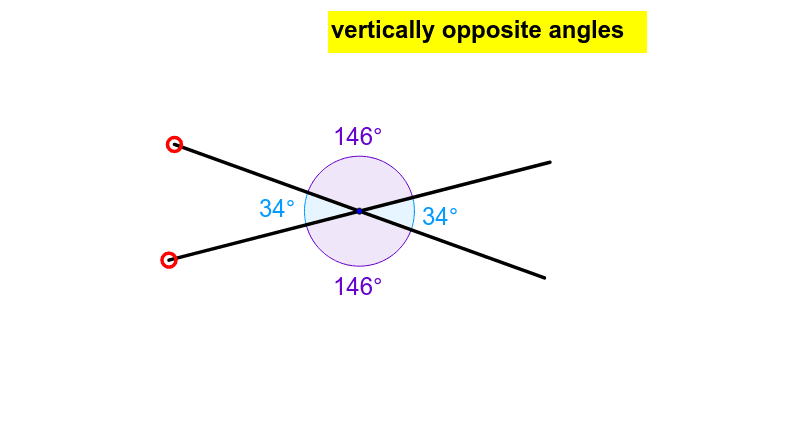
Students can explore the properties of vertically opposite angles by moving the red points. This example covers the core concept of vertically opposite angles and uses GeoGebra commands such as Circle, Point, Ray, Intersect, Segment, and Angle. Suitable for middle school and above students learning geometric construction.
GeoGebra Commands & Parameters
Circle(A, a) → cPoint(c) → BRay(B, A) → bPoint(c) → CRay(C, A) → dIntersect(c, d, 2) → DIntersect(c, b, 2) → EIntersect(c, b, 2) → FSegment(B, F) → eIntersect(c, d, 2) → GSegment(C, G) → fAngle(B, A, C) → αAngle(E, A, G) → βAngle(C, A, B) → γAngle(G, A, E) → δAngle(C, A, E) → εAngle(G, A, B) → ζAngle(E, A, C) → ηAngle(B, A, G) → θ
AI Drawing Prompt Reference
Draw two intersecting lines to form four angles. Select a point on each line and draw circles centered at these points. The intersection of the circles gives a point on the circumference. Connect each center to this point to form two rays. These rays intersect the original lines at four points. Connect the opposite vertices to form two segments. Measure and label the angles, showing that opposite angles are equal.
The prompt above was compiled from the original drawing commands and is for reference only.