
Invariance of the Sum of Areas: A Dynamic Geometry Demonstration
Loading the math board and drawing, please wait…
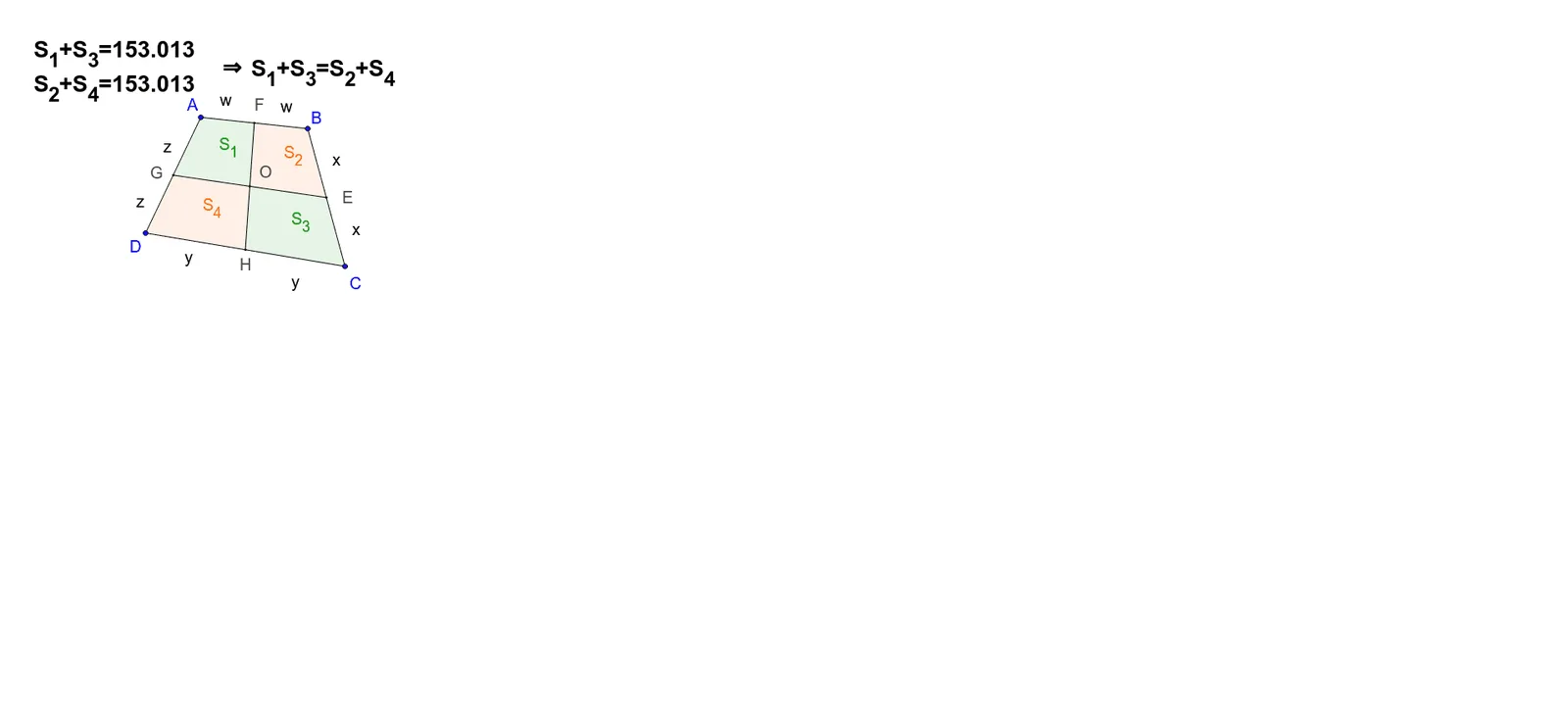
① This GeoGebra example demonstrates a geometric phenomenon where the total area of multiple polygons remains invariant under certain transformations, such as rotation or subdivision. ② Core mathematical concepts include area conservation, polygon decomposition and recombination, rotational symmetry, and connections to upper/lower Riemann sums, providing an intuitive model for area accumulation in integral calculus. ③ Construction highlights: using GeoGebra commands Polygon, Midpoint, Segment, and Intersect to build the base figure; objects include points A, B, C, D, polygon poly1, segments a, b, c, d, midpoints E, F, G, H, intersection O, and auxiliary polygons S_1 through S_4, along with function-related objects, enabling dynamic rotation or subdivision to illustrate the invariant sum. ④ Suitable for upper secondary to early university students, this example serves as a visual aid in geometry teaching, an introduction to pre-calculus concepts like Riemann sums, and a dynamic exploration tool. By dragging or animating, learners can observe the constancy of the area sum, deepening their understanding of area conservation and transformation invariance.
GeoGebra Commands & Parameters
Polygon(A, B, C, D) → poly1, a, b, c, dMidpoint(b) → EMidpoint(a) → FMidpoint(d) → GMidpoint(c) → HSegment(F, H) → eSegment(G, E) → fIntersect(e, f) → OPolygon(F, B, E, O) → S_2, f_1, b_1, e_1, iPolygon(A, F, O, G) → S_1, a_1, f_2, i_1, gPolygon(G, O, H, D) → S_4, g_1, i_2, h, d_1Polygon(E, O, H, C) → S_3, e_2, i_3, h_1, c_1Segment(B, E) → mSegment(E, C) → nSegment(C, H) → pSegment(H, D) → qSegment(D, G) → rSegment(G, A) → sSegment(A, F) → tSegment(F, B) → j_1