
Intuitive Graphical Understanding of Logarithms
Loading the math board and drawing, please wait…
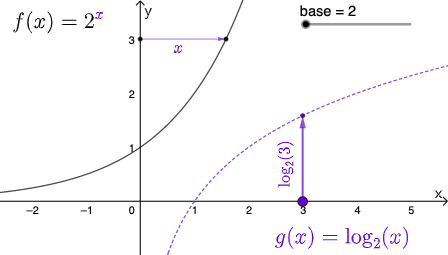
This example demonstrates the properties and graph of logarithmic functions through an intuitive, graphical approach. It involves core math concepts like logarithms, exponential functions, function graphs, and area. GeoGebra commands and objects used in construction include Point, Intersect, Vector, Segment, Circle, Rotate, RotateText. Suitable for high school mathematics students to understand the relationship and graph characteristics between logarithmic and exponential functions.
GeoGebra Commands & Parameters
Point(Ray[(0.1, 0), (1, 0)]) → AIntersect(g, eq1, (3, 1.584962500721156)) → BVector(A, B) → uSegment(A, C) → hPoint(h) → DCircle(D, Length[u]) → cRotate(E, (((-Distance[A, D])) / h * π / 2), D) → E'Vector(D, E') → vIntersect(f, p, (1.5849625006479855, 3)) → FVector(C, F) → wRotateText(text1, π / 2) → text4RotateText(text4, ((-(Distance[A, D] / h)) * π / 2)) → text5
AI Drawing Prompt Reference
Create a coordinate-plane graphic illustrating key properties of logarithmic and exponential functions using a geometric construction. Start by defining a rightward ray from the origin and place a base point A. Choose a point B as the intersection of the given curve g with a specified condition, using the approximate location (3, 1.584962500721156). Form a direction from A to B, then build a horizontal/reference segment of length h from A and mark the corresponding point D on that segment. Draw a circle centered at D with radius equal to the chosen direction length. Rotate the reference direction around D by about a right-angle amount to obtain a point E′, then use the direction from D to E′. Intersect the other given function (curve f with condition p) with the line implied by this construction to locate F at approximately (1.5849625006479855, 3). Connect the constructed points to emphasize the logarithm–exponential geometric relationship, and add rotated text annotations to indicate the angle/rotation used in the construction.
The prompt above was compiled from the original drawing commands and is for reference only.