
Factoring Quadratic Polynomials with Geometric Verification
Loading the math board and drawing, please wait…
In collections
Arithmetic and Algebra
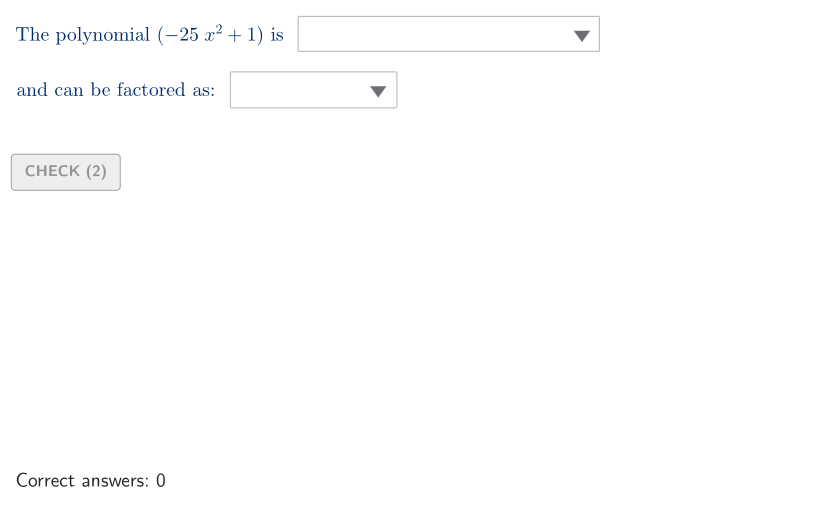
This example demonstrates how to verify the factorization of quadratic polynomials using geometric constructions. Key mathematical concepts include quadratic polynomials, factorization, and geometric verification. Construction involves GeoGebra commands like Shuffle, Element, Polygon, etc. Suitable for middle or high school mathematics to understand the relationship between factorization and geometric properties.
GeoGebra Commands & Parameters
Shuffle({1, 2, 3, 4}) → allCaseNum, {4, 1, 2, 3}Element(allCaseNum, Mod[countQuestion, Length[allCaseNum]] + 1) → caseNumShuffle(Sequence[t, t, -7, 7, 1] \ {0}) → allA, {5, -4, -7, -1, -5, 7, 4, 1, -3, -2, 6, -6, 2, 3}Element(allA, Mod[countQuestion, Length[allA]] + 1) → numAShuffle(Sequence[t, t, -7, 7, 1] \ {0, numA, (-numA)}) → allB, {-1, 3, 1, -6, -2, -7, 6, -4, 4, -3, 2, 7}Element(allB, Mod[countQuestion, Length[allB]] + 1) → numBPolynomial(((numA * x) + numB)^(2)) → given1Polynomial((((numA * x) + numB) * ((numA * x) - numB))) → given2Polynomial(((((-numA) * x) + numB) * ((numA * x) + numB))) → given4Polynomial(x^(2) + ((numA + numB) * x) + (numA * numB)) → given3Shuffle({1, 2, 3, 4, 5, 6}) → ddOrder, {6, 4, 2, 5, 3, 1}Append("$\phantom{ABCDEFppqq}$", Zip[choices(A), A, ddOrder]) → ddMenu2SelectedIndex(ddMenu1) → is1SelectedIndex(ddMenu2) → is2Polygon({DataMin, (x(DataMin), y(DataMax)), DataMax, (x(DataMax), y(DataMin))}) → viewBoxSegment((x(DataMin), 0), (x(DataMax) + (10 * windowWidth / PXwindowWidth), 0)) → axisXSegment((0, y(DataMin)), (0, y(DataMax) + (10 * windowHeight / PXwindowHeight))) → axisYIf(x(DataMin) < 0, If[y(DataMin) ≟ 0, (0, -1), If[y(DataMin) < 0, (-1, -1), (0, -1)]], If[y(DataMin) < 0, (-1, 0), (-1, -1)]) → zeroOffsetJoin({Sequence[A, A, (-xIncrement), x(DataMin), (-xIncrement)], Sequence[A, A, xIncrement, x(DataMax), xIncrement]}) → xLblPosJoin({Sequence[A, A, (-yIncrement), y(DataMin), (-yIncrement)], Sequence[A, A, yIncrement, y(DataMax), yIncrement]}) → yLblPosSort(Join[{Sequence[0, x(DataMax), xIncrement], Sequence[(-xIncrement), x(DataMin), (-xIncrement)]}]) → xValuesZip((A, Max[0, y(DataMin)]), A, xValues) → xPointsJoin({Sequence[0, y(DataMax), yIncrement], Sequence[(-yIncrement), y(DataMin), (-yIncrement)]}) → yValuesZip((Max[0, x(DataMin)], A), A, yValues) → yPoints
AI Drawing Prompt Reference
Create a geometric diagram to verify factorization of quadratic polynomials. Randomly select two nonzero integers as coefficients, generating four distinct quadratic polynomials representing perfect square, difference of squares, negative coefficient product, and general form. Display their function graphs on a coordinate plane with axes and grid ticks. Below the graphs, place two dropdown menus for selecting question number and answer choice, enabling interactive verification of factorization. The background is a rectangular region with labeled axes and tick marks.
The prompt above was compiled from the original drawing commands and is for reference only.