
Introduction to Completing the Square by Tim Brzezinski
Loading the math board and drawing, please wait…
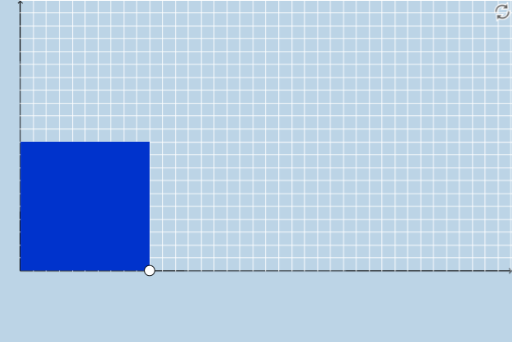
This example demonstrates the application of completing the square in quadratic functions through dynamic geometry, visually presenting the process of geometric completion. Key math concepts include quadratic functions, difference of squares, geometric补形, and area transformation. GeoGebra commands and objects like Segment, Polygon, Sequence, Point, Dilate, Rotate, Vector, Translate, Distance, and Textfield are used to simulate the completion process dynamically. Suitable for high school mathematics education, helping students understand the geometric meaning and algebraic derivation of completing the square, enhancing spatial reasoning skills.
GeoGebra Commands & Parameters
Segment(A, B) → fSegment(D, C) → hSegment(C, A) → iPolygon(A, B, D, C) → poly1, a_1, b_1, d, cSequence((a + i, 0), i, 0, abs(b / 2), 1) → bottomsSequence((a + i, a), i, 0, abs(b / 2), 1) → topsSequence((0, a + i), i, 0, abs(b / 2), 1) → leftsSequence((a, a + i), i, 0, abs(b / 2), 1) → rightsSequence(Dilate[Element[bottoms, i], If[0 < g ≤ 1, 1 - g, 0], Element[tops, i]], i, 0, abs(b / 2) + 1, 1) → bottomsmoveSequence(Dilate[Element[lefts, i], If[1 < g ≤ 2, 2 - g, 0], Element[rights, i]], i, 0, abs(b / 2) + 1, 1) → leftsmovePoint(bottomsmove) → ESegment(B, E) → jDilate(C, If[1 < g ≤ 2, 2 - g, 0], D) → C'Segment(C, C') → kPolygon(D, H, F, G) → poly2, d_1, h_1, f_1, g_1Dilate(H, If[2 < g ≤ 3, 3 - g, 0], F) → H'Dilate(G, If[2 < g ≤ 3, 3 - g, 0], F) → G'Dilate(I, If[2 < g ≤ 3, 3 - g, 0], A) → I'Segment(I, I') → lRotate(I, If[3 < g ≤ 4, ((-(g - 3)) * π / 2), ((-π)) / 2], A) → I'_1Rotate(I', If[3 < g ≤ 4, ((-(g - 3)) * π / 2), ((-π)) / 2], A) → I''Segment(I'_1, I'') → l'Rotate(I'_1, If[4 < g ≤ 5, ((-(g - 4)) * π / 2), ((-π)) / 2], I'_1) → JRotate(I'', If[4 < g ≤ 5, ((-(g - 4)) * π / 2), ((-π)) / 2], I'_1) → I'''Segment(J, I''') → l''Dilate(A, If[5 < g ≤ 6, 6 - g, 0], I) → A'Vector(A, A') → uTranslate(I'_1, u) → KTranslate(I'', u) → I'''_1Segment(K, I'''_1) → l''_1Sequence(Segment[Element[bottoms, i + 1], Element[bottomsmove, i + 2]], i, 1, abs(b / 2), 1) → list1Sequence(Segment[Element[lefts, i + 1], Element[leftsmove, i + 2]], i, 1, abs(b / 2), 1) → list2Sequence(Polygon[Element[bottoms, i], Element[bottoms, i + 1], Element[tops, i + 1], Element[tops, i]], i, 1, abs(b / 2), 1) → list3Sequence(Polygon[Element[lefts, i], Element[lefts, i + 1], Element[rights, i + 1], Element[rights, i]], i, 1, abs(b / 2), 1) → list4Distance(D, F) → distanceDFTextfield(b) → InputBox1