
Intersection of Two Cylinders (Steinmetz Solid) in GeoGebra
Loading the math board and drawing, please wait…
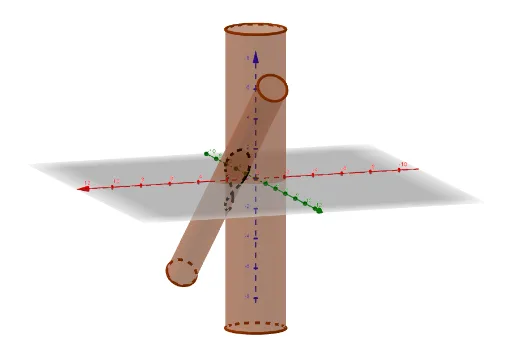
This GeoGebra example dynamically illustrates the intersection of two cylinders with different radii and perpendicular axes, forming a Steinmetz solid. It visualizes the curve of intersection, surface boundaries, and enables computation of the enclosed volume via definite integrals. Core mathematical concepts include analytic geometry of surfaces, trigonometric parametric representation, optimization using Max/Min, and integral calculus for volume evaluation. Construction leverages GeoGebra commands such as CurveCartesian, Point, Cylinder, and parametric angle variables (θ, α, β) to generate and manipulate the 3D geometry. The model is suitable for calculus and solid geometry courses, supporting both teaching volume integration and exploring spatial optimization problems.
GeoGebra Commands & Parameters
Max(0, s - r) → α_{min}Min(R, s + r) → α_{max}Max((-R), s - r) → β_{min}Min(0, s + r) → β_{max}CurveCartesian((R^(2) - t^(2))^(0.5), t, (1 / sin(θ) * ((t * cos(θ)) + (t^(2) - R^(2) + r^(2) - s^(2) + ((2 * s) * (R^(2) - t^(2))^(0.5)))^(0.5))), t, y_{α1}, y_{α2}) → γ_{α12}CurveCartesian((R^(2) - t^(2))^(0.5), t, (1 / sin(θ) * ((t * cos(θ)) - (t^(2) - R^(2) + r^(2) - s^(2) + ((2 * s) * (R^(2) - t^(2))^(0.5)))^(0.5))), t, y_{α1}, y_{α2}) → δ_{α12}CurveCartesian((R^(2) - t^(2))^(0.5), t, (1 / sin(θ) * ((t * cos(θ)) + (t^(2) - R^(2) + r^(2) - s^(2) + ((2 * s) * (R^(2) - t^(2))^(0.5)))^(0.5))), t, y_{α3}, y_{α4}) → γ_{α34}CurveCartesian((R^(2) - t^(2))^(0.5), t, (1 / sin(θ) * ((t * cos(θ)) - (t^(2) - R^(2) + r^(2) - s^(2) + ((2 * s) * (R^(2) - t^(2))^(0.5)))^(0.5))), t, y_{α3}, y_{α4}) → δ_{α34}CurveCartesian((-(R^(2) - t^(2))^(0.5)), t, (1 / sin(θ) * ((t * cos(θ)) + (t^(2) - R^(2) + r^(2) - s^(2) - ((2 * s) * (R^(2) - t^(2))^(0.5)))^(0.5))), t, y_{β1}, y_{β2}) → γ_{β12}CurveCartesian((-(R^(2) - t^(2))^(0.5)), t, (1 / sin(θ) * ((t * cos(θ)) - (t^(2) - R^(2) + r^(2) - s^(2) - ((2 * s) * (R^(2) - t^(2))^(0.5)))^(0.5))), t, y_{β1}, y_{β2}) → δ_{β12}CurveCartesian((-(R^(2) - t^(2))^(0.5)), t, (1 / sin(θ) * ((t * cos(θ)) + (t^(2) - R^(2) + r^(2) - s^(2) - ((2 * s) * (R^(2) - t^(2))^(0.5)))^(0.5))), t, y_{β3}, y_{β4}) → γ_{β34}CurveCartesian((-(R^(2) - t^(2))^(0.5)), t, (1 / sin(θ) * ((t * cos(θ)) - (t^(2) - R^(2) + r^(2) - s^(2) - ((2 * s) * (R^(2) - t^(2))^(0.5)))^(0.5))), t, y_{β3}, y_{β4}) → δ_{β34}Point({0, 0, -10}) → APoint({0, 0, 10}) → BCylinder(A, B, R) → a, c, d, bPoint({s, (12 * sin(θ)), (12 * cos(θ))}) → DPoint({s, (-12 * sin(θ)), (-12 * cos(θ))}) → CCylinder(C, D, r) → e, f, g, h
AI Drawing Prompt Reference
Draw the intersection of two perpendicular cylinders forming a Steinmetz solid, showing the curve of intersection, surface boundaries, and compute the enclosed volume. First, draw two cylinders, one fixed along the z-axis and the other rotating around the x-axis. Then, plot the upper and lower parts of the intersection curve, and the left and right sections to form a closed solid. Finally, add auxiliary lines around the shape to indicate the integration boundaries for volume calculation.
The prompt above was compiled from the original drawing commands and is for reference only.