
Intersection of Sphere and Cylinder (GeoGebra)
Loading the math board and drawing, please wait…
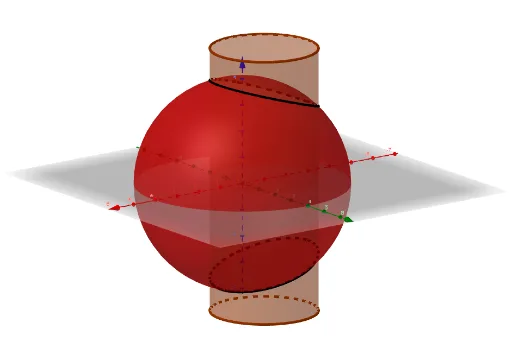
This GeoGebra example demonstrates the spatial intersection curve formed when a sphere and a cylinder intersect, visualizing the geometric shape of the intersection of two quadric surfaces in 3D. Core mathematical concepts include solid geometry, surface intersection, parametric curves, and similarity transformations (scaling) affecting the intersection shape. Construction details: the Cylinder and Sphere commands create the two surfaces, while CurveCartesian is used to plot the intersection curve parametrically; objects include R and r as radii, s as a scaling factor, ξ and η as parameters, a, c, d, b, e controlling position and orientation, and γ and δ series representing different branches of the intersection curves. Suitable for high school or early university students learning solid geometry and spatial analytic geometry, and for teachers creating interactive lessons to illustrate how intersection curves are generated and parameterized.
GeoGebra Commands & Parameters
Cylinder(Point[{s, 0, 5}], Point[{s, 0, -5}], r) → a, c, d, bSphere(Point[{0, 0, 0}], R) → eCurveCartesian(ξ(ζ), η(ζ), ζ, ζ, ζ_1, ζ_2) → γ_{uu}CurveCartesian(ξ(ζ), (-η(ζ)), ζ, ζ, (-ζ_2), (-ζ_1)) → γ_{dd}CurveCartesian(ξ(ζ), (-η(ζ)), ζ, ζ, ζ_1, ζ_2) → γ_{ud}CurveCartesian(ξ(ζ), η(ζ), ζ, ζ, (-ζ_2), (-ζ_1)) → γ_{du}CurveCartesian((r^(2) - η^(2))^(0.5), η, (R^(2) - r^(2))^(0.5), η, (-r), r) → δ_{uu}CurveCartesian((-(r^(2) - η^(2))^(0.5)), η, (R^(2) - r^(2))^(0.5), η, (-r), r) → δ_{ud}CurveCartesian((r^(2) - η^(2))^(0.5), η, (-(R^(2) - r^(2))^(0.5)), η, (-r), r) → δ_{du}CurveCartesian((-(r^(2) - η^(2))^(0.5)), η, (-(R^(2) - r^(2))^(0.5)), η, (-r), r) → δ_{dd}
AI Drawing Prompt Reference
Create a three‑dimensional scene that includes a sphere centered at the origin with radius R and a vertical cylinder whose axis passes through the points (s,0,5) and (s,0,−5) and has radius r. Show the intersection of these two surfaces by drawing the curve where they meet. The intersection consists of four parametric branches, each defined by functions of parameters ξ and η, covering the full curve in all quadrants. Render the sphere and cylinder as smooth surfaces, and draw the intersection curves with a distinct line style to highlight how the sphere and cylinder intersect in space.
The prompt above was compiled from the original drawing commands and is for reference only.