
Intersection of Two Cylinders: Parametric Construction
Loading the math board and drawing, please wait…
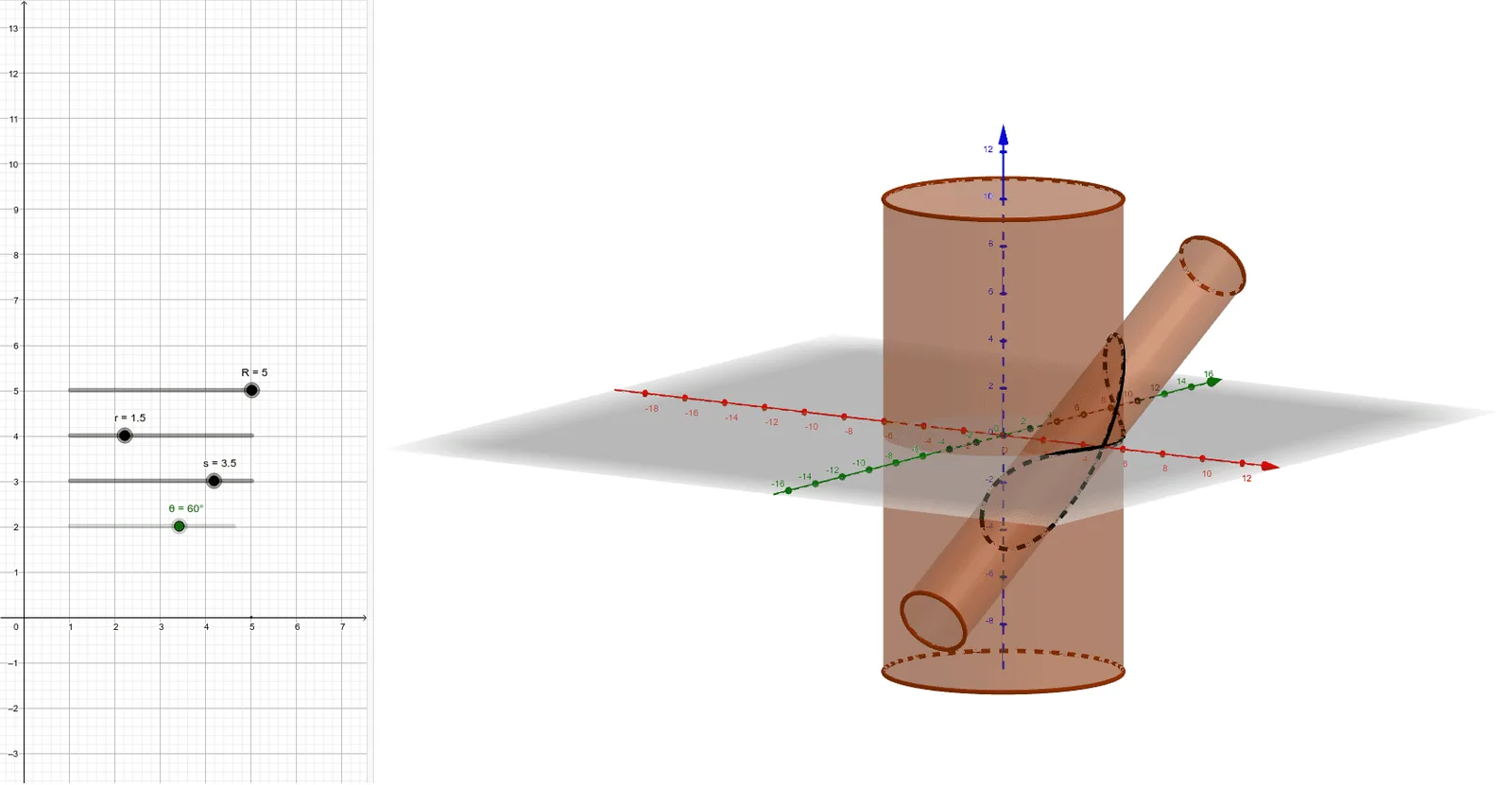
This example demonstrates the geometric construction and visualization of the intersection curve (space curve) formed by two intersecting cylinders in 3D space. The core mathematical concepts involve solid geometry, equations of intersecting surfaces, parametric equations, and extremum (max/min) calculations. Construction highlights: using GeoGebra commands Max and Min to determine the ranges of angular parameters α and β, CurveCartesian to create parametric curves, Point to mark intersection points, and Cylinder to generate the cylindrical surfaces. Objects include radii R and r, parameters s and θ, and multiple auxiliary points (A, B, C, D) and curves (a, b, c, d, etc.). This example is suitable for high school or university courses in solid geometry, analytic geometry, or computer-aided geometry, helping students intuitively understand the complex spatial curve resulting from the intersection of two cylinders.
GeoGebra Commands & Parameters
Max(0, s - r) → α_{min}Min(R, s + r) → α_{max}Max((-R), s - r) → β_{min}Min(0, s + r) → β_{max}CurveCartesian((R^(2) - t^(2))^(0.5), t, (1 / sin(θ) * ((t * cos(θ)) + (t^(2) - R^(2) + r^(2) - s^(2) + ((2 * s) * (R^(2) - t^(2))^(0.5)))^(0.5))), t, y_{α1}, y_{α2}) → γ_{α12}CurveCartesian((R^(2) - t^(2))^(0.5), t, (1 / sin(θ) * ((t * cos(θ)) - (t^(2) - R^(2) + r^(2) - s^(2) + ((2 * s) * (R^(2) - t^(2))^(0.5)))^(0.5))), t, y_{α1}, y_{α2}) → δ_{α12}CurveCartesian((R^(2) - t^(2))^(0.5), t, (1 / sin(θ) * ((t * cos(θ)) + (t^(2) - R^(2) + r^(2) - s^(2) + ((2 * s) * (R^(2) - t^(2))^(0.5)))^(0.5))), t, y_{α3}, y_{α4}) → γ_{α34}CurveCartesian((R^(2) - t^(2))^(0.5), t, (1 / sin(θ) * ((t * cos(θ)) - (t^(2) - R^(2) + r^(2) - s^(2) + ((2 * s) * (R^(2) - t^(2))^(0.5)))^(0.5))), t, y_{α3}, y_{α4}) → δ_{α34}CurveCartesian((-(R^(2) - t^(2))^(0.5)), t, (1 / sin(θ) * ((t * cos(θ)) + (t^(2) - R^(2) + r^(2) - s^(2) - ((2 * s) * (R^(2) - t^(2))^(0.5)))^(0.5))), t, y_{β1}, y_{β2}) → γ_{β12}CurveCartesian((-(R^(2) - t^(2))^(0.5)), t, (1 / sin(θ) * ((t * cos(θ)) - (t^(2) - R^(2) + r^(2) - s^(2) - ((2 * s) * (R^(2) - t^(2))^(0.5)))^(0.5))), t, y_{β1}, y_{β2}) → δ_{β12}CurveCartesian((-(R^(2) - t^(2))^(0.5)), t, (1 / sin(θ) * ((t * cos(θ)) + (t^(2) - R^(2) + r^(2) - s^(2) - ((2 * s) * (R^(2) - t^(2))^(0.5)))^(0.5))), t, y_{β3}, y_{β4}) → γ_{β34}CurveCartesian((-(R^(2) - t^(2))^(0.5)), t, (1 / sin(θ) * ((t * cos(θ)) - (t^(2) - R^(2) + r^(2) - s^(2) - ((2 * s) * (R^(2) - t^(2))^(0.5)))^(0.5))), t, y_{β3}, y_{β4}) → δ_{β34}Point({0, 0, -10}) → APoint({0, 0, 10}) → BCylinder(A, B, R) → a, c, d, bPoint({s, (12 * sin(θ)), (12 * cos(θ))}) → DPoint({s, (-12 * sin(θ)), (-12 * cos(θ))}) → CCylinder(C, D, r) → e, f, g, h
AI Drawing Prompt Reference
Draw the intersection curve of two intersecting cylinders in 3D space, which is a space curve. First determine the ranges of radii and parameters, then use Cartesian parametric equations to plot the intersection curve. Also draw the two cylinders and mark auxiliary points and curves to show the geometric construction process.
The prompt above was compiled from the original drawing commands and is for reference only.