
Intersection of Cylinder and Paraboloid by Jose Manuel Arranz
Loading the math board and drawing, please wait…
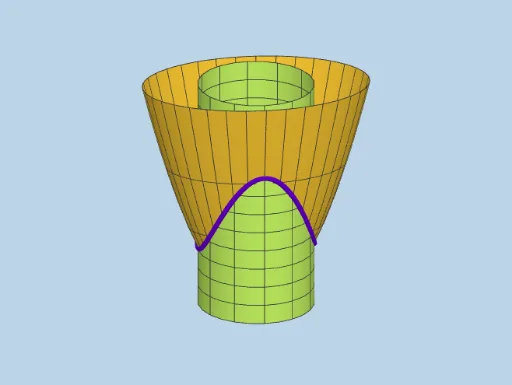
This example demonstrates the intersection curve of a cylinder and a paraboloid. Key mathematical concepts include the intersection of surfaces in coordinate geometry and parametric equations. Using GeoGebra commands such as Intersect, Surface, and CurveCartesian, the intersection curve can be dynamically displayed. Suitable for high school mathematics education or research.
GeoGebra Commands & Parameters
Intersect(yAxis, zAxis) → FSurface(((c * u) * cos(v)), ((d * u) * sin(v)), u^(2), u, 0, sqrt(h), v, 0, (2 * π)) → gSurface((a * cos(u)), (b * sin(u)), v, u, 0, (2 * π), v, 0, h) → fCurveCartesian((a * cos(t)), (b * sin(t)), e((a * cos(t)), (b * sin(t))), t, 0, (2 * π)) → iCurveCartesian((a * cos(t)), (b * sin(t)), t, 0, (2 * π)) → e_1
AI Drawing Prompt Reference
Draw a 3D coordinate system with a cylinder and a paraboloid. The cylinder is vertical along the z-axis, with an elliptical cross-section (radii a and b) and height h. The paraboloid opens upward, vertex at origin, with cross-section controlled by parameters c and d, also extending to height h. The two surfaces intersect, forming a spatial curve whose projection on the xy-plane is an ellipse. Additionally, draw an ellipse on the z=0 plane as a reference. Show the intersection relationship clearly, emphasizing the shape of the intersection curve.
The prompt above was compiled from the original drawing commands and is for reference only.