
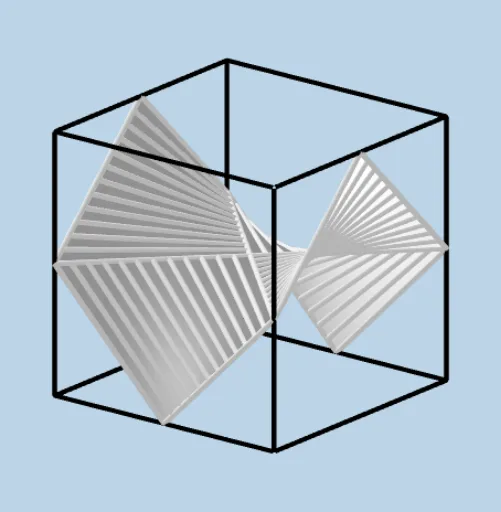
Half of a Cube via Four Hyperbolic Paraboloid Patches
Loading the math board and drawing, please wait…
In collections
Dissecting a cube into equal parts
This example demonstrates how to form a “half-cube” style structure using four hyperbolic paraboloid surface patches arranged inside an axis-aligned cube. It highlights key ideas from solid geometry and surface construction: finding midpoints and median segments, leveraging symmetry to relate the cube’s faces, and using congruence-type correspondences to ensure the patches meet consistently. Construction workflow in GeoGebra: create the cube with Cube; compute crucial points with Midpoint; build supporting edges using Segment and Line; generate the curved pieces using Surface; replicate and assemble them via Mirror for symmetric placement; and use Sequence for managing parameter-driven surface definitions. The model also references cube edges (“arista”) and faces (“cara”) to define where each patch is bounded. Suitable for advanced high school through early university audiences studying 3D geometry, analytic geometry, and the visualization of parametric/ruled surfaces.
GeoGebra Commands & Parameters
Cube(A, B, C) → b, D, caraCDHG, caraEFGH, aristaAD, aristaAB, aristaBC, aristaCD, aristaAE, aristaDH, aristaEH, aristaEF, E, aristaBF, aristaFG, aristaCG, aristaGH, F, G, H, caraABCD, caraADHE, caraABFE, caraBCGFMidpoint(aristaEH) → IMidpoint(aristaAE) → JMidpoint(aristaAB) → KSegment(J, I) → fSegment(J, K) → gMidpoint(aristaBF) → LSegment(K, L) → hMidpoint(aristaFG) → MSegment(M, L) → iMidpoint(aristaCG) → NMidpoint(aristaCD) → OSegment(M, N) → jSegment(N, O) → kMidpoint(aristaDH) → PSegment(I, P) → lSegment(P, O) → mMidpoint(A, G) → QSegment(Q, L) → n_{1}Surface((g(t) * k) + (n_{1}(t) * (1 - k)), k, 0, 1, t, 0, 1) → s3Mirror(s3, Plane[y = 0]) → s1Line(J, N) → pMirror(s3, p) → s4Mirror(s1, p) → s2Mirror(l1, (0, 0, 0)) → l1'Sequence(N + (i * (Q - N) / n), i, 0, n) → l2Sequence(O + (i * (P - O) / n), i, 0, n) → l3Zip(Segment[A, B], A, l2, B, l3) → l4Sequence(N + (i * (M - N) / n), i, 0, n) → l5Sequence(Q + (i * (L - Q) / n), i, 0, n) → l6Zip(Segment[A, B], A, l5, B, l6) → l7LaTeX(l6, true, true) → texto1Sequence(J + (i * (K - J) / n), i, 0, n - 1) → l8Sequence(J + (i * (Q - J) / n), i, 0, n) → l9Sequence(K + (i * (L - K) / n), i, 0, n) → l10Zip(Segment[A, B], A, l9, B, l10) → l11Sequence(J + (i * (I - J) / n), i, 0, n) → l12Sequence(Q + (i * (P - Q) / n), i, 0, n) → l13Zip(Segment[A, B], A, l12, B, l13) → l14
AI Drawing Prompt Reference
Create a half-cube structure using four hyperbolic paraboloid patches. Start by creating an axis-aligned cube, then find key points like midpoints and median segments. Use symmetry to place the hyperbolic paraboloid patches inside the cube, ensuring smooth connections at the boundaries. Finally, generate and assemble these patches using mirroring and sequence operations to form the half-cube structure.
The prompt above was compiled from the original drawing commands and is for reference only.