
Intersection of Cylinder and Cone by Jose Manuel Arranz
Loading the math board and drawing, please wait…
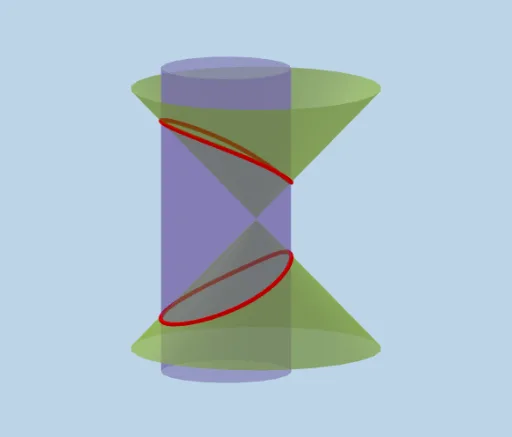
This example demonstrates the double curve solid formed by the intersection of a cylinder and a cone. It involves core mathematical concepts such as solid geometry, rotational solids, intersection curves, definite integrals, and trigonometric functions. The construction uses GeoGebra commands like CurveCartesian and Surface, along with objects like rotasi, rotano, ejessi, ejesno, botón3, botón1, Opac, rastrono, b, r, a, d, g, opac2, c, e, con, cil. It is suitable for high school and above students studying solid geometry, calculus, and spatial visualization skills.
GeoGebra Commands & Parameters
CurveCartesian((a * cos(t)), d + (a * sin(t)), (1 / r * sqrt((d + (a * sin(t)))^(2) + (a^(2) * cos(t)^(2)))), t, 0, (2 * π)) → cCurveCartesian((a * cos(t)), d + (a * sin(t)), (-1 / r * sqrt((d + (a * sin(t)))^(2) + (a^(2) * cos(t)^(2)))), t, 0, (2 * π)) → eSurface(((r * u) * cos(v)), ((r * u) * sin(v)), u, u, -3, 3, v, 0, (2 * π)) → conSurface((a * cos(u)), d + (a * sin(u)), v, u, 0, (2 * π), v, -3.5, 3.5) → cil