
Integral vs Midpoint Rectangle Sum
Loading the math board and drawing, please wait…
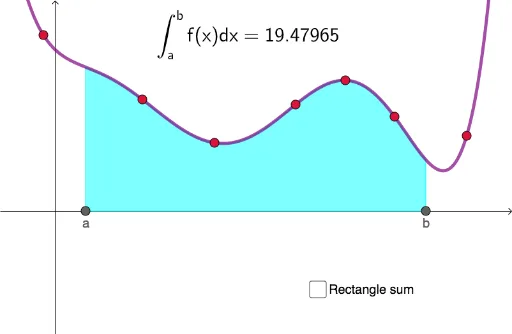
This example illustrates the relationship between definite integrals and midpoint rectangle sums. It covers key concepts in calculus such as integrals and rectangle sums. Using GeoGebra commands like Integral and RectangleSum, it provides a visual demonstration of integral approximation methods. Suitable for high school calculus courses and learning.
GeoGebra Commands & Parameters
Sort({A_1, B_1, C, D, E, F, G}) → L_1Segment((x(L_1(1)), 0), (x(L_1(7)), 0)) → jPoint(j) → aPoint(j) → bFitPoly(L_1, 6) → fIntegral(f, x(a), x(b)) → a_1Segment(a, (x(a), f(x(a)))) → gSegment(b, (x(b), f(x(b)))) → hRectangleSum(f, x(a), x(b), n, 0.5) → cRectangleSum(f, x(a), x(b), n, 0.5) → d
AI Drawing Prompt Reference
Plot a 6th-degree polynomial curve passing through several data points, select an interval on the x-axis, draw vertical lines from the interval endpoints to the curve, display the definite integral area under the curve between the endpoints, and use midpoint rectangle sum method to draw multiple rectangles in the same interval to approximate the integral, demonstrating the relationship between definite integrals and rectangle approximations with adjustable endpoints.
The prompt above was compiled from the original drawing commands and is for reference only.