
Inscribed Angle Theorem (V1)
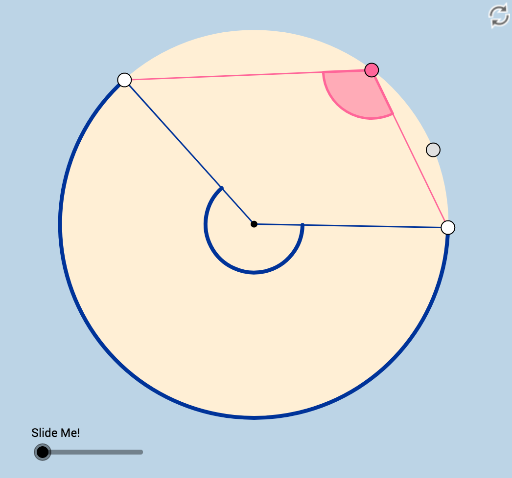
Loading the math board and drawing, please wait…
This applet uses a transformational geometry 'proof without words' approach to help students readily discover the inscribed angle theorem. It demonstrates that an inscribed angle is half the measure of its intercepted arc's central angle. Core concepts include inscribed angles, central angles, arcs, and geometric transformations such as rotation, translation, and dilation. The construction employs GeoGebra commands: Circle, Point, CircleArc, Segment, Angle, Rotate, Intersect, CircleSector, Dilate, Vector, Translate, and Line. Objects include points A, B, C, D, E, F, arcs, segments, angles α, β, γ, and transformed copies. Suitable for middle and high school geometry classes, this interactive tool encourages students to explore angle relationships dynamically and develop a visual proof of the theorem.
GeoGebra Commands & Parameters
Circle(A, B) → cPoint(c) → CPoint(c) → DCircleArc(A, D, C) → dPoint(d) → EPoint(d) → FCircleArc(A, C, D) → eSegment(A, C) → aSegment(A, D) → bSegment(E, C) → fSegment(E, D) → gSegment(F, C) → hSegment(F, D) → iAngle(C, A, D) → αRotate(C, α / 2, A) → C'Angle(C, A, C') → βSegment(A, C') → jCircle(E, (0.25 * Distance[A, B])) → kIntersect(k, f, 1) → GIntersect(k, g, 1) → HCircle(F, (0.25 * Distance[A, B])) → pIntersect(p, h, 1) → JIntersect(p, i, 1) → KCircleSector(E, G, H) → qCircleSector(F, J, K) → rDilate(E, If[0 < l ≤ 1, 1 - l, 0], A) → E'Vector(E, E') → uTranslate(q, u) → q'Line(E, a) → mIntersect(k, m, 2) → LAngle(L, E, G) → γRotate(q', If[1 < l ≤ 2, ((-(l - 1)) * γ), (-γ)], A) → q''Dilate(E, If[2 < l ≤ 3, 3 - l, 0], A) → E'_1Vector(E, E'_1) → vTranslate(q, v) → q'_1Line(E, j) → nIntersect(k, n, 2) → MAngle(M, E, G) → δRotate(q'_1, If[3 < l ≤ 4, ((l - 3) * (360° - δ)), (-δ)], A) → sCircle(A, (0.25 * Distance[A, B])) → tIntersect(t, a, 1) → NIntersect(t, j, 1) → OIntersect(t, c, 1) → IIntersect(t, b) → P,CircleArc(A, N, P) → c_1
AI Drawing Prompt Reference
Draw a circle and select three points A, B, and C on it. Connect A and B to form a diameter. Rotate point C around A to be symmetric with B, forming an inscribed angle. Then draw the arcs corresponding to the central angle and the inscribed angle. Use rotation and dilation to show that the inscribed angle is half the measure of the central angle.
The prompt above was compiled from the original drawing commands and is for reference only.