
Visualizing Division of a Whole Number by a Fraction
Loading the math board and drawing, please wait…
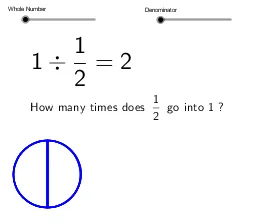
This GeoGebra example provides an interactive visual demonstration of dividing a whole number by a fraction, making the abstract arithmetic operation tangible through geometric representation. The core mathematical concept is fraction division, specifically that dividing by a fraction is equivalent to multiplying by its reciprocal. The construction uses circles, sectors, rotations, and angles to model the division process: a whole unit is represented as a circle, and fractional parts are shown as sectors created by rotating radii. Key GeoGebra commands include Circle, Rotate, Angle, and CircleSector, with numerous points (A, B, C, D, E, F, etc.) and angle variables (α, β, γ, etc.) defined to step through the division. This resource is ideal for upper elementary and middle school students learning fraction operations, as well as for teachers seeking a dynamic visual aid to explain why dividing by a fraction yields a larger result. It bridges arithmetic and geometry, enhancing conceptual understanding through interactive exploration.
GeoGebra Commands & Parameters
Circle(A, 2.5) → cCircle(B, 2.5) → dCircle(C, 2.5) → eRotate(O, (360 / Denominator)°, A) → O'Angle(O, A, O') → αRotate(O', (360 / Denominator)°, A) → O''Angle(O', A, O'') → βRotate(O'', (360 / Denominator)°, A) → O'''Angle(O'', A, O''') → γRotate(O''', (360 / Denominator)°, A) → DAngle(O''', A, D) → δRotate(D, (360 / Denominator)°, A) → D'Angle(D, A, D') → εRotate(D', (360 / Denominator)°, A) → D''Angle(D', A, D'') → ζRotate(D'', (360 / Denominator)°, A) → D'''Angle(D'', A, D''') → ηRotate(D''', (360 / Denominator)°, A) → EAngle(D''', A, E) → θRotate(E, (360 / Denominator)°, A) → E'Angle(E, A, E') → ιRotate(E', (360 / Denominator)°, A) → E''Angle(E', A, E'') → κRotate(F, (360 / Denominator)°, B) → F'Angle(F, B, F') → λRotate(F', (360 / Denominator)°, B) → F''Angle(F', B, F'') → μRotate(F'', (360 / Denominator)°, B) → F'''Angle(F'', B, F''') → νRotate(F''', (360 / Denominator)°, B) → GAngle(F''', B, G) → ξRotate(G, (360 / Denominator)°, B) → G'Angle(G, B, G') → οRotate(G', (360 / Denominator)°, B) → G''Angle(G', B, G'') → ρRotate(G'', (360 / Denominator)°, B) → G'''Angle(G'', B, G''') → σRotate(G''', (360 / Denominator)°, B) → HAngle(G''', B, H) → τRotate(H, (360 / Denominator)°, B) → H'Angle(H, B, H') → υRotate(H', (360 / Denominator)°, B) → H''Angle(H', B, H'') → ϕRotate(I, (360 / Denominator)°, C) → I'Angle(I, C, I') → χRotate(I', (360 / Denominator)°, C) → I''Angle(I', C, I'') → ψRotate(I'', (360 / Denominator)°, C) → I'''Angle(I'', C, I''') → ωRotate(I''', (360 / Denominator)°, C) → JAngle(I''', C, J) → α_1Rotate(J, (360 / Denominator)°, C) → J'Angle(J, C, J') → β_1Rotate(J', (360 / Denominator)°, C) → J''Angle(J', C, J'') → γ_1Rotate(J'', (360 / Denominator)°, C) → J'''Angle(J'', C, J''') → δ_1Rotate(J''', (360 / Denominator)°, C) → KAngle(J''', C, K) → ε_1Rotate(K, (360 / Denominator)°, C) → K'Angle(K, C, K') → ζ_1Rotate(K', (360 / Denominator)°, C) → K''Angle(K', C, K'') → η_1CircleSector(A, O, O') → fCircleSector(A, O', O'') → gCircleSector(A, O'', O''') → hCircleSector(A, O''', D) → kCircleSector(A, D, D') → pCircleSector(A, D', D'') → qCircleSector(A, D'', D''') → rCircleSector(A, D''', E) → sCircleSector(A, E, E') → tCircleSector(A, E', O) → c_1CircleSector(B, F, F') → d_1CircleSector(B, F'', F''') → e_1CircleSector(B, F', F'') → f_1CircleSector(B, F''', G) → g_1CircleSector(B, G, G') → h_1CircleSector(B, G', G'') → k_1CircleSector(B, G'', G''') → p_1CircleSector(B, G''', H) → q_1CircleSector(B, H, H') → r_1CircleSector(B, H', F) → s_1CircleSector(C, I, I') → t_1CircleSector(C, I', I'') → c_2CircleSector(C, I'', I''') → d_2CircleSector(C, I''', J) → e_2CircleSector(C, J, J') → f_2CircleSector(C, J', J'') → g_2CircleSector(C, J'', J''') → h_2CircleSector(C, J''', K) → k_2CircleSector(C, K, K') → p_2CircleSector(C, K', I) → q_2
AI Drawing Prompt Reference
Draw a circle to represent a whole number and visualize dividing it by a fraction through rotations. Divide the circle into equal sectors with angles of 360 degrees divided by the fraction's denominator. Rotate these sectors sequentially to demonstrate that dividing by a fraction is equivalent to multiplying by its reciprocal. Use a slider to adjust the fraction's value and observe how the number of rotations and the resulting shape change, providing an intuitive understanding of fraction division.
The prompt above was compiled from the original drawing commands and is for reference only.