
Fraction Division Demonstration by bnewhous
Loading the math board and drawing, please wait…
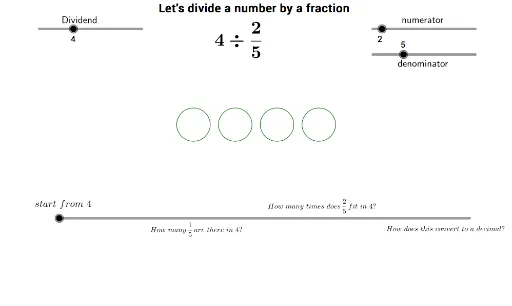
This example dynamically illustrates the calculation and geometric interpretation of fraction division. It covers core concepts like fraction operations, matrices, angles, logarithmic functions, and statistical diagrams. Constructed using GeoGebra commands like Sequence and objects such as a, c, d, text elements, lists, and sliders, it is suitable for middle school and above to understand the interdisciplinary connections of fraction division.
GeoGebra Commands & Parameters
Sequence(CircleSector[C, (x(C) + (r * sin((((i + 1) * 2) * π / d))), y(C) + (r * cos((((i + 1) * 2) * π / d)))), (x(C) + (r * sin(((i * 2) * π / d))), y(C) + (r * cos(((i * 2) * π / d))))], i, 0, c - 1) → list1Sequence(Circle[((((-(a - 1)) * 2.5) * r / 2) + ((k * 2.5) * r), 0), r], k, 0, a - 1) → list2Sequence(Sequence[CircleSector[((((-(a - 1)) * 2.5) * r / 2) + ((k * 2.5) * r), 0), ((((-(a - 1)) * 2.5) * r / 2) + ((k * 2.5) * r) + (r * sin((((i + 1) * 2) * π / d))), (r * cos((((i + 1) * 2) * π / d)))), ((((-(a - 1)) * 2.5) * r / 2) + ((k * 2.5) * r) + (r * sin(((i * 2) * π / d))), (r * cos(((i * 2) * π / d))))], i, 0, d - 1], k, 0, a - 1) → list4Sequence(CircleSector[(cent(f(k)), 0), (cent(f(k)) - (r * sin(((part(f(k)) * 2) * π / d))), (r * cos(((part(f(k)) * 2) * π / d)))), (cent(f(k)) - (r * sin((((part(f(k)) + 1) * 2) * π / d))), (r * cos((((part(f(k)) + 1) * 2) * π / d))))], k, 1, (floor(((a * d) - c) / ((4 * c)) + 1) * c)) → liste1Sequence(CircleSector[(cent(f(k) + c), 0), (cent(f(k) + c) - (r * sin(((part(f(k) + c) * 2) * π / d))), (r * cos(((part(f(k) + c) * 2) * π / d)))), (cent(f(k) + c) - (r * sin((((part(f(k) + c) + 1) * 2) * π / d))), (r * cos((((part(f(k) + c) + 1) * 2) * π / d))))], k, 1, (floor(((a * d) - (2 * c)) / ((4 * c)) + 1) * c)) → liste2Sequence(CircleSector[(cent(f(k) + (2 * c)), 0), (cent(f(k) + (2 * c)) - (r * sin(((part(f(k) + (2 * c)) * 2) * π / d))), (r * cos(((part(f(k) + (2 * c)) * 2) * π / d)))), (cent(f(k) + (2 * c)) - (r * sin((((part(f(k) + (2 * c)) + 1) * 2) * π / d))), (r * cos((((part(f(k) + (2 * c)) + 1) * 2) * π / d))))], k, 1, (floor(((a * d) - (3 * c)) / ((4 * c)) + 1) * c)) → liste3Sequence(CircleSector[(cent(f(k) + (3 * c)), 0), (cent(f(k) + (3 * c)) - (r * sin(((part(f(k) + (3 * c)) * 2) * π / d))), (r * cos(((part(f(k) + (3 * c)) * 2) * π / d)))), (cent(f(k) + (3 * c)) - (r * sin((((part(f(k) + (3 * c)) + 1) * 2) * π / d))), (r * cos((((part(f(k) + (3 * c)) + 1) * 2) * π / d))))], k, 1, (floor(((a * d) - (4 * c)) / ((4 * c)) + 1) * c)) → liste4
AI Drawing Prompt Reference
Draw a sequence of sectors on a circle to illustrate the geometric interpretation of fraction division. Start by drawing a circle, then draw multiple sectors around the center with equal angles. Each sector's center and radius are calculated based on formulas. Next, draw a series of concentric circles with different radii. Finally, according to the rules of fraction division, draw multiple sector sequences, with each sequence's sector center and radius also calculated based on formulas.
The prompt above was compiled from the original drawing commands and is for reference only.