
Converting from Equatorial to Galactic Coordinates
Loading the math board and drawing, please wait…
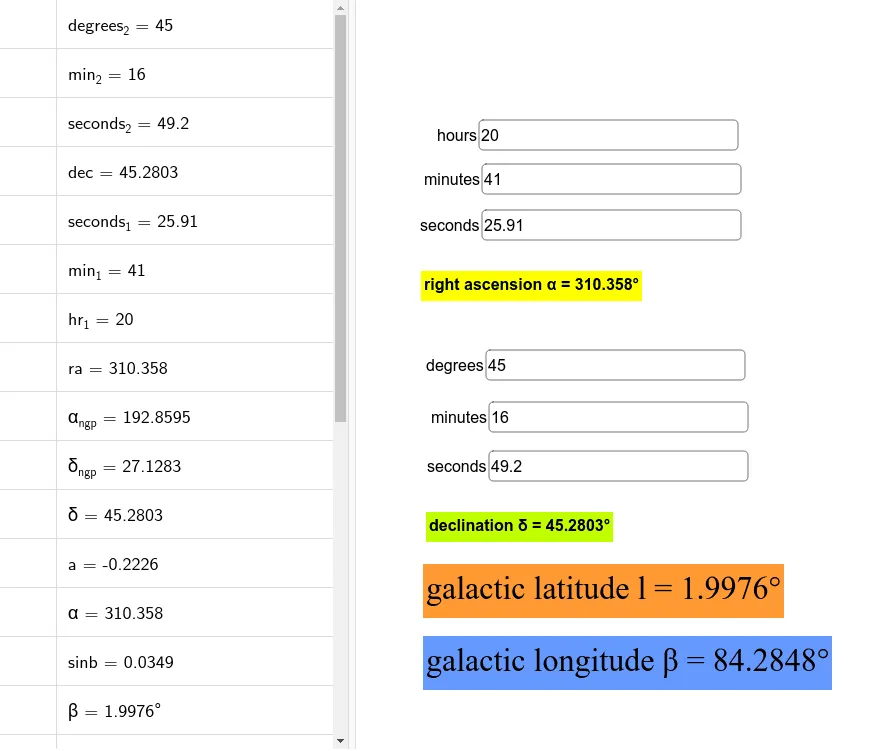
This GeoGebra example demonstrates the conversion of celestial coordinates from the equatorial system (right ascension and declination) to the galactic system (galactic longitude and latitude). It provides an interactive interface with six input boxes for entering the hour, minute, second components of right ascension and the degree, minute, second components of declination. The core mathematical concepts involve spherical trigonometry, trigonometric functions (sine, cosine, tangent), and coordinate rotation formulas, incorporating parameters such as the galactic north pole (α_ngp, δ_ngp) and the longitude of the ascending node. The construction uses GeoGebra commands like Textfield and InputBox, along with intermediate variables (dec, ra, sinb, β, l_NCP, k_1, cos_123minusl, sin_123minusl, tan_123minusl, φ, l) to compute the galactic latitude and longitude step by step. This resource is suitable for high school or university courses in astronomy, mathematics, or physics, as well as for astronomy enthusiasts seeking to understand the relationships between different celestial coordinate systems.
GeoGebra Commands & Parameters
Textfield(hr_1) → InputBox1Textfield(min_1) → InputBox2Textfield(seconds_1) → InputBox3Textfield(degrees_2) → InputBox4Textfield(min_2) → InputBox5Textfield(seconds_2) → InputBox6