
Incenter is Its Own Isogonal Conjugate
Loading the math board and drawing, please wait…
In collections
A Tour of Triangle Geometry
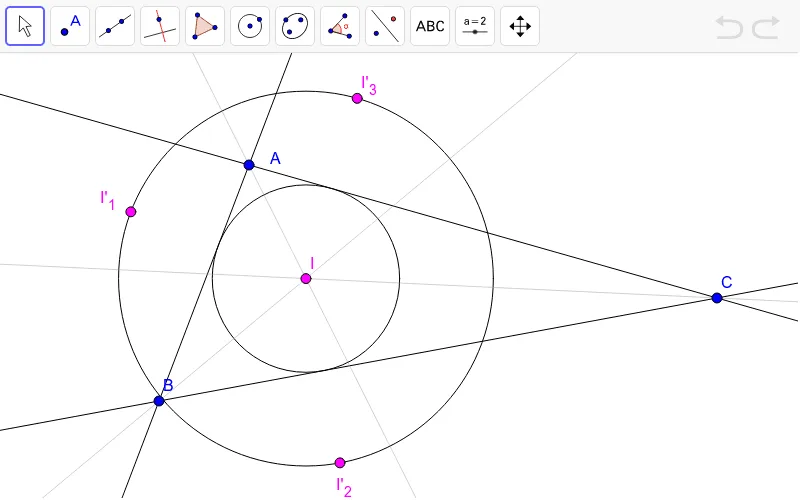
This example demonstrates that the incenter (I) is its own isogonal conjugate. Key mathematical concepts include the incenter of a triangle and isogonal conjugates. Using GeoGebra commands such as Line, AngularBisector, Intersect, OrthogonalLine, Circle, Segment, and Mirror, the construction of the incenter's isogonal conjugate is illustrated. Suitable for high school geometry learners and math enthusiasts.
GeoGebra Commands & Parameters
Line(A, B) → aLine(B, C) → bLine(C, A) → cAngularBisector(B, A, C) → dAngularBisector(C, B, A) → eAngularBisector(A, C, B) → fIntersect(d, e) → IOrthogonalLine(I, c) → gIntersect(c, g) → DCircle(I, D) → hIntersect(h, a) → E, KIntersect(h, c) → F, GIntersect(h, b) → H, JSegment(E, C) → iSegment(A, H) → jSegment(B, F) → kIntersect(i, j) → G_eMirror(I, c) → I'_3Mirror(I, a) → I'_1Mirror(I, b) → I'_2Circle(I'_1, I'_3, I'_2) → p
AI Drawing Prompt Reference
Draw a triangle, mark its incenter and the three angle bisectors, then find the symmetric points of the incenter with respect to the triangle's sides, and finally connect these symmetric points to form a circle, demonstrating that the incenter is its own isogonal conjugate.
The prompt above was compiled from the original drawing commands and is for reference only.