
IM 6.1.14 Lesson: Nets and Surface Area – Activities 1 & 2 (Unassembled)
Loading the math board and drawing, please wait…
In collections
Grade 6 Unit 1: Area and Surface Area
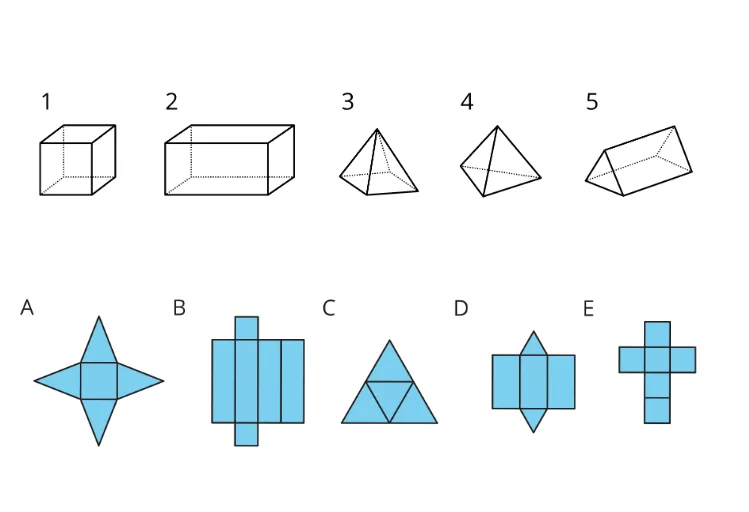
This GeoGebra example illustrates nets and surface area for Activities 1 and 2 of the IM 6.1.14 lesson, presented without physical assembly. It demonstrates how three-dimensional solids such as prisms and pyramids can be unfolded into two-dimensional nets composed of polygons, enabling students to visualize and calculate total surface area by summing the areas of individual faces. Core mathematical concepts include solid geometry, nets, surface area, polygon area, and spatial reasoning. The construction relies on GeoGebra objects A, B, C, D and image objects pic1, pic2, using points and pictures to represent the connectivity and layout of faces in the net. Suitable for middle school mathematics (approximately grades 6–8), this resource supports classroom demonstrations, inquiry-based activities, and surface-area practice.
GeoGebra Commands & Parameters
Point A(-11.437978615763928, -1.7353127183765986)Point B(2.1933129696168576, -1.7627951610890602)Point C(-11.048644010670731, 3.2802330766475674)Point D(2.126439025683201, 3.2802330766475674)
AI Drawing Prompt Reference
Create a 2D diagram in a coordinate plane using four key points that define a rectangular layout: place point A in the lower-left, point B in the lower-right, point C in the upper-left, and point D in the upper-right. Connect them so the outline shows two horizontal boundary segments and two vertical boundary connections, with A and B aligned on one horizontal level, C and D aligned on another, and A with C on the left side while B with D on the right. The result should look like a simple rectangle used as a 2D net-face placement reference for an unfolded 3D solid.
The prompt above was compiled from the original drawing commands and is for reference only.