
Icosahedron Net
Loading the math board and drawing, please wait…
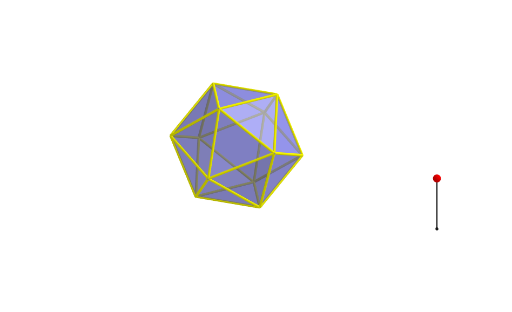
This example demonstrates the net of an icosahedron, a polyhedron composed of 20 equilateral triangles. Using GeoGebra commands such as Point, Icosahedron, Segment, Rotate, etc., the net of the icosahedron can be constructed. Suitable for students at the junior high school level and above to learn solid geometry.
GeoGebra Commands & Parameters
Point(Circle[Midpoint[A, B], (Distance[A, B] * sqrt(3) / 2), Segment[A, B]]) → CIcosahedron(A, B, C) → a, D, faceABC, faceACF, faceAFG, faceADG, faceABD, faceBDH, faceBEH, faceBCE, faceCEI, faceCFI, E, faceEHK, faceEIK, faceIKL, faceFIL, faceHJK, faceJKL, faceGJL, faceFGL, faceDHJ, faceDGJ, F, edgeAC, edgeAB, edgeBC, edgeAF, edgeCF, edgeAG, edgeFG, edgeAD, edgeDG, edgeBD, G, edgeBH, edgeDH, edgeBE, edgeEH, edgeCE, edgeCI, edgeEI, edgeFI, edgeEK, edgeHK, H, edgeIK, edgeIL, edgeKL, edgeFL, edgeJK, edgeHJ, edgeJL, edgeGL, edgeGJ, edgeDJ, I, J, K, LSegment(M, M + (0, 0, 2)) → bPoint(b) → NRotate(Polygon[A, B, D], (α * t), Segment[A, B]) → poly1Rotate(Polygon[A, D, G], (α * t), Segment[A, D]) → poly2Rotate(Polygon[B, D, H], (α * t), Segment[D, B]) → poly3Rotate(Polygon[G, D, J], (α * t), Segment[G, D]) → poly4Rotate(Polygon[D, H, J], (α * t), Segment[D, H]) → poly5Rotate(Polygon[G, J, L], (α * t), Segment[G, J]) → poly6Rotate(poly2, (α * t), Segment[A, B]) → poly2'Rotate(poly3, (α * t), Segment[A, B]) → poly3'Rotate(poly4, (α * t), Segment[A, D]) → poly4'Rotate(poly4', (α * t), Segment[A, B]) → poly4''Rotate(poly5, (α * t), Segment[D, B]) → poly5'Rotate(poly5', (α * t), Segment[A, B]) → poly5''Rotate(poly6, (α * t), Segment[G, D]) → poly6'Rotate(poly6', (α * t), Segment[A, D]) → poly6''Rotate(poly6'', (α * t), Segment[A, B]) → poly6'''Rotate(Polygon[J, K, L], (α * t), Segment[L, J]) → poly7Rotate(poly7, (α * t), Segment[G, J]) → poly7'Rotate(poly7', (α * t), Segment[G, D]) → poly7''Rotate(poly7'', (α * t), Segment[A, D]) → poly7'''Rotate(poly7''', (α * t), Segment[A, B]) → poly8Circle(A, B, C) → cCenter(c) → OOrthogonalLine(O, Plane[A, B, C]) → dRotate(poly1, 120°, d) → poly1'Rotate(poly2', 120°, d) → poly2''Rotate(poly3', 120°, d) → poly3''Rotate(poly4'', 120°, d) → poly4'''Rotate(poly5'', 120°, d) → poly5'''Rotate(poly6''', 120°, d) → poly9Rotate(poly1', 120°, d) → poly1''Rotate(poly2'', 120°, d) → poly2'''Rotate(poly3'', 120°, d) → poly3'''Rotate(poly4''', 120°, d) → poly10Rotate(poly5''', 120°, d) → poly11Rotate(poly9, 120°, d) → poly9'Polygon(A, B, C) → poly12, c_1, a_1, b_1Polygon(A, B, C) → poly13, c_2, a_2, b_2Rotate(poly1', 120°, d) → poly1''_1Rotate(Polygon[A, B, D], (α * t), Segment[A, B]) → poly14Rotate(poly1, 120°, d) → poly1'_1Rotate(poly3', 120°, d) → poly3''_1Rotate(poly2'', 120°, d) → poly2'''_1Rotate(poly2', 120°, d) → poly2''_1Rotate(poly2, (α * t), Segment[A, B]) → poly2'_1Rotate(poly3, (α * t), Segment[A, B]) → poly3'_1Rotate(poly5', (α * t), Segment[A, B]) → poly5''_1Rotate(poly4', (α * t), Segment[A, B]) → poly4''_1Rotate(poly6'', (α * t), Segment[A, B]) → poly6'''_1Rotate(poly7''', (α * t), Segment[A, B]) → poly15Rotate(poly3'', 120°, d) → poly3'''_1Rotate(poly5''', 120°, d) → poly16Rotate(poly4''', 120°, d) → poly17Rotate(poly9, 120°, d) → poly9'_1Rotate(poly5'', 120°, d) → poly5'''_1Rotate(poly4'', 120°, d) → poly4'''_1Rotate(poly6''', 120°, d) → poly18