
Icosahedron and Balloon
Loading the math board and drawing, please wait…
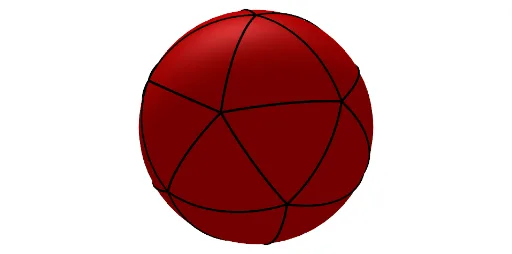
This example demonstrates the geometric relationship between an icosahedron and a balloon, showing surface transformations. It involves core math concepts like solid geometry, integral calculus, and variance analysis. GeoGebra commands used include Intersect, Point, Sphere, etc. Suitable for high school students and math enthusiasts exploring spatial geometry and calculus applications.
GeoGebra Commands & Parameters
Intersect(zAxis, xAxis) → APoint(zAxis) → BSphere(A, B) → aIntersectPath(xOyPlane, a) → cIntersect(xAxis, c) → C, DIntersect(yAxis, c) → E, FIntersect(xAxis, zAxis) → HRotate(C, 72°, A, xOyPlane) → C'Angle(C, A, C', xOyPlane) → αRotate(C', 72°, A, xOyPlane) → C''Angle(C', A, C'', xOyPlane) → βRotate(C'', 72°, A, xOyPlane) → C'''Angle(C'', A, C''', xOyPlane) → γRotate(C''', 72°, A, xOyPlane) → GAngle(C''', A, G, xOyPlane) → δCircleArc(A, B, C''') → dCircleArc(A, B, G) → eCircleArc(A, B, C) → fCircleArc(A, B, C') → gCircleArc(A, B, C'') → hIntersect(zAxis, a) → I, JRotate(C, 36°, A, xOyPlane) → C'_1Angle(C, A, C'_1, xOyPlane) → εRotate(C'_1, 72°, A, xOyPlane) → KAngle(C'_1, A, K, xOyPlane) → ζRotate(K, 72°, A, xOyPlane) → K'Angle(K, A, K', xOyPlane) → ηRotate(K', 72°, A, xOyPlane) → K''Angle(K', A, K'', xOyPlane) → θRotate(K'', 72°, A, xOyPlane) → K'''Angle(K'', A, K''', xOyPlane) → ιCircleArc(A, I, K'') → kPoint(zAxis) → LCircleArc(L, K', I) → pCircleArc(L, K''', I) → qCircleArc(L, K, I) → rCircleArc(L, C'_1, I) → sDistance(A, B) → ABSphere(B, i) → jIntersectConic(j, a) → tIntersect(f, t) → M, N, ,Intersect(g, t) → O, P, ,Intersect(h, t) → Q, R, ,Intersect(t, d) → S, T, ,Intersect(t, e) → U, V, ,Sphere(I, i) → lIntersectConic(l, a) → c_1Intersect(q, c_1) → W, Z, ,Intersect(c_1, s) → A_1, B_1, ,Intersect(c_1, k) → C_1, D_1, ,Intersect(c_1, r) → E_1, F_1, ,Intersect(p, c_1) → G_1, H_1, ,CircleArc(L, B, N) → d_1CircleArc(L, N, U) → e_1CircleArc(L, B, U) → f_1CircleArc(L, N, W) → g_1Point(g_1) → I_1CircleArc(L, U, I_1) → h_1CircleArc(L, S, U) → k_1CircleArc(L, N, P) → p_1CircleArc(L, B, P) → q_1CircleArc(L, S, B) → r_1CircleArc(L, B, R) → s_1CircleArc(L, R, S) → t_1CircleArc(L, R, P) → c_2CircleArc(L, P, F_1) → d_2CircleArc(L, R, F_1) → e_2CircleArc(H, R, G_1) → f_2CircleArc(H, S, G_1) → g_2CircleArc(H, F_1, G_1) → h_2Intersect(t, k_1, 2) → J_1CircleArc(H, J_1, C_1) → k_2CircleArc(H, U, C_1) → p_2CircleArc(H, C_1, I_1) → q_2CircleArc(H, C_1, G_1) → r_2CircleArc(H, I_1, B_1) → s_2CircleArc(H, I_1, I) → t_2CircleArc(H, C_1, I) → c_3CircleArc(H, I, B_1) → d_3CircleArc(H, G_1, I) → e_3CircleArc(H, B_1, F_1) → f_3CircleArc(H, F_1, I) → g_3CircleArc(H, B_1, P) → h_3CircleArc(H, B_1, N) → k_3Intersect(t_1, t, 1) → K_1Polygon(B, R, S) → poly1, s_3, b_1, r_3Intersect(t, k_1, 1) → L_1Polygon(B, S, U) → poly2, u, b_2, s_4Polygon(S, C_1, L_1) → poly3, l_1, s_5, c_4Polygon(S, R, G_1) → poly4, g_4, s_6, r_4Polygon(S, G_1, C_1) → poly5, c_5, s_7, g_5Polygon(P, K_1, B) → poly6, b_3, p_3, k_4Polygon(B, N, U) → poly7, u_1, b_4, nPolygon(U, I_1, C_1) → poly8, c_6, u_2, i_1Polygon(P, N, B) → poly9, b_5, p_4, n_1Polygon(I_1, B_1, N) → poly10, n_2, i_2, b_6Polygon(N, P, B_1) → poly11, b_7, n_3, p_5Polygon(B_1, F_1, P) → poly12, p_6, b_8, f_4Polygon(P, F_1, K_1) → poly13, k_5, p_7, f_5Polygon(F_1, G_1, R) → poly14, r_5, f_6, g_6Polygon(F_1, I, G_1) → poly15, g_7, f_7, i_3Intersect(c_1, h_3, 1) → M_1Polygon(B_1, F_1, I) → poly16, i_4, b_9, f_8Polygon(I_1, B_1, I) → poly17, i_5, i_6, b_{10}Polygon(G_1, I, C_1) → poly18, c_7, g_8, i_7Intersect(c_3, q_2, 1) → N_1Polygon(I_1, C_1, I) → poly19, i_8, i_9, c_8Polygon(L_1, N, I_1) → t1, j_1, m_1, n_4