
Hyperbola Property 1: Tangents, Intersections, and Parallelogram Construction
Loading the math board and drawing, please wait…
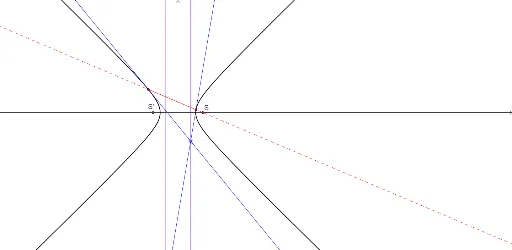
This example demonstrates a classic geometric property of a hyperbola: when tangents are drawn at two points on the hyperbola, the quadrilateral formed by the tangent intersection and the two points (or related segments) exhibits parallelogram or rectangle relationships. Core mathematical concepts include the definition of a hyperbola, tangent equations, chord of contact, and using analytic geometry to prove geometric properties. Construction highlights: using GeoGebra commands such as Point to place points on the hyperbola, Tangent to draw tangents, Intersect to find tangent intersections, and Segment/Line to construct auxiliary segments and lines, allowing dynamic dragging to observe invariant properties. Suitable for high school or college analytic geometry courses to understand tangent properties and geometric constructions of hyperbolas, as well as for mathematical experiments or inquiry-based learning.
GeoGebra Commands & Parameters
Point(d) → ATangent(A, c) → g, hIntersect(c, g) → BIntersect(c, h) → CSegment(B, C) → iLine(C, B) → j
AI Drawing Prompt Reference
Draw a hyperbola and choose two points on it. Construct tangents at these two points, each intersecting the hyperbola again at another point. Connect these two new intersection points with a segment, then extend this segment into a line. The final figure should show the hyperbola, the two tangents, the two tangent points, the two intersection points, and the segment and line formed by them, illustrating the geometric relationship between tangents and intersections on a hyperbola.
The prompt above was compiled from the original drawing commands and is for reference only.