
Hinged Dissection Proof of Pythagoras' Theorem
Loading the math board and drawing, please wait…
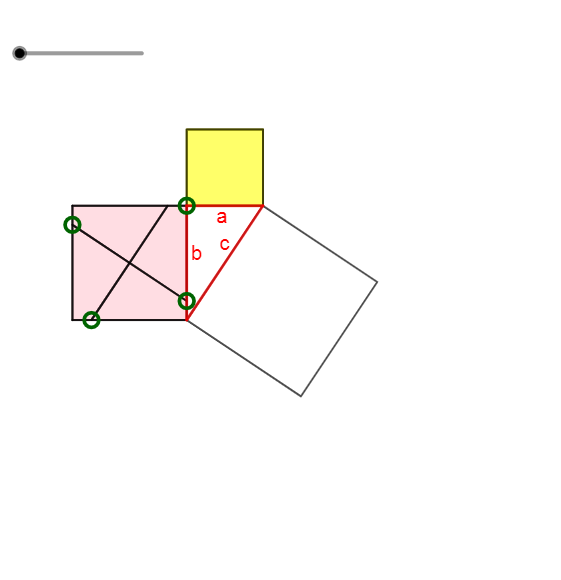
This example demonstrates Pythagoras' Theorem using hinged dissection. It shows how a square can be divided into several parts and then reassembled to form the sum of the areas of two smaller squares. Key mathematical concepts include geometric construction, transformation, and area calculation. GeoGebra commands used include Midpoint, Rotate, Polygon, and Vector. Suitable for middle school and above students to learn geometric transformations and area calculation.
GeoGebra Commands & Parameters
If(t > 0.5, (2 * (t - 0.5)), 0) → t1If(t < 0.5, (2 * t), 1) → t0Midpoint(A, C - (3, 0)) → ORotate(O, 90°, A) → O'Polygon(A, C, C - (3, 0), A - (3, 0)) → q1, f, g, h, iRotate(B, -90°, C) → B'Vector(O', B') → uPolygon(A, B, C) → t1_{1}, j, k, lLine(O, k) → mIntersect(m, g) → FIntersect(m, i) → DOrthogonalLine(O, m) → nIntersect(n, l) → GIntersect(n, h) → EPolygon({O, D, H, E}) → q3Polygon({A, B, B + (0, 2), A + (0, 2)}) → q2Polygon({O, E, I, F}) → q4Polygon({O, F, C, G}) → q5Polygon({O, G, A, D}) → q6Translate(Rotate[Rotate[Rotate[Rotate[q3, (180° * t0), E], (180° * t0), F], (180° * t0), G], (90° * t0), A], Vector[(t1 * u)]) → q3'Translate(Rotate[Rotate[Rotate[q4, (180° * t0), F], (180° * t0), G], (90° * t0), A], Vector[(t1 * u)]) → q4'Translate(Rotate[Rotate[q5, (180° * t0), G], (90° * t0), A], Vector[(t1 * u)]) → q5'Translate(Rotate[q6, (90° * t0), A], Vector[(t1 * u)]) → q6'Rotate(C, 90°, B) → C'Polygon({B, C, B', C'}) → q7Translate(q2, Vector[(t1 * u)]) → q2'Translate(A, Vector[(t1 * u)]) → A'Translate(Rotate[G, (90° * t0), A], Vector[(t1 * u)]) → JTranslate(Rotate[Rotate[F, (180° * t0), G], (90° * t0), A], Vector[(t1 * u)]) → KTranslate(Rotate[Rotate[Rotate[E, (180° * t0), F], (180° * t0), G], (90° * t0), A], Vector[(t1 * u)]) → L
AI Drawing Prompt Reference
Create a geometric “hinged dissection” diagram for Pythagoras’ theorem. Start with a triangle defined by three main vertices, then build a construction using a midpoint near one side as a rotation/symmetry center and determine a direction via a vector from a rotated position. Draw several polygons that together form the outer square partition and the corresponding sub-region outlines, with some edges tied to the rotation centers. Add auxiliary lines and an orthogonal line to compute intersection points that serve as key connection vertices for the pieces. Finally, move the pieces using a common translation vector and apply successive rotations about the relevant points so the parts remain hinged and rearrange into the layout whose sub-squares’ areas match the intended Pythagorean relationship.
The prompt above was compiled from the original drawing commands and is for reference only.